By Ismael Peña-López (@ictlogist), 01 July 2025
Main categories: Cyberlaw, governance, rights, e-Government, e-Administration, Politics, News
Other tags: artificial_intelligence, mission-oriented_policy, public_procurement, stakeholder_engagement
No Comments »
For the last months I have been working analysing the public procurement of artificial intelligence solutions in Public Administration. The results have now been published as a playbook: Meaningful Stakeholder Engagement in Public Procurement for Artificial Intelligence. A Mission-Oriented Playbook.
The general goal of the research, fostered and commissioned by ParticipationAI, is whether AI is just a regular technology that can be purchased yet as another commodity, or is it “something else”. Our thesis is that, effectively, it is much more than something else. And that, at least, two crucial aspects should be taken into account:
- Purpose, aimed at the public interest.
- Impact, as it has a high transforming potential.
In both cases, we believe that the meaningful concurrence of a plural diversity of actors is strictly necessary at all stages of the life cycle of AI. Thus, Ai procurement needs quite a different framework from that of traditional procurement:
- Deal with it like the investment in a digital public infrastructure.
- Think of the concurrence of many different actors, and have a strategy on how to best engage them.
- Organise governance of AI procurement as a mission-oriented policy.
Resources:
Abstract
Artificial Intelligence is rapidly becoming a general-purpose technology with significant potential for transformation at all levels. The public sector is increasingly adopting it for a range of purposes – from improving public service delivery to designing and implementing policies – including promoting and shaping the technology itself in the public interest.
However, this potential does not come without challenges. The deployment of artificial intelligence has revealed serious issues, notably the quantity and quality of data required, the difficulty in training algorithms and understanding their inner workings, and the need to ensure compliance with administrative procedures and human rights more broadly. Ultimately, there is a persistent struggle to control its entire lifecycle.
As a result, the procurement of AI has diverged significantly from the conventional acquisition of standard technologies, as new complexities emerge in defining its purpose, shaping its delivery, and ensuring the transparency, predictability, accountability, and measurability of its impact.
To gain insight into this shift, we conduct expert interviews and a thorough literature review on the public procurement of artificial intelligence solutions and carry out interviews with key actors directly involved in the process.
Preliminary findings suggest that a comprehensive model is still lacking, although it draws heavily on previous experiences in data governance and digital privacy, particularly in relation to delivery.
However, the road ahead – especially beyond the strictly technical domain, in terms of purpose and impact – has been explored but remains largely uncharted, although there appears to be emerging consensus around the importance of meaningful stakeholder engagement, both quantitatively and qualitatively: the field is too vast and dynamic to be managed solely by public administrations or their contractors, and too complex to be addressed without the involvement of a diverse range of actors and publics, spanning various approaches, frameworks, disciplines, and roles.
In this playbook, we propose a future direction that identifies the key stages at which, and the ways in which, stakeholder engagement can add value to the entire process of public procurement of artificial intelligence solutions
Executive summary
Artificial Intelligence (AI) is reshaping economies, institutions, and societies at unprecedented speed and scale. As a general-purpose technology, AI holds significant potential for transformation – yet it also poses complex challenges, particularly in the context of democratic governance and the public sector.
Public administrations are increasingly adopting AI to enhance service delivery, optimise internal operations, and inform public policy. However, the integration of AI into public decision-making processes introduces new risks around transparency, accountability, equity, and public trust, among others. These challenges are particularly pronounced in the procurement and deployment of AI systems within the public sector.
A complex transformation
Unlike traditional technologies, AI systems evolve, interact with large-scale datasets, and often operate as opaque decision-making tools. Public procurement processes – typically designed for static, well-defined goods or services – struggle to accommodate the dynamic, systemic, and high-risk nature of AI systems. Existing procurement guidelines often do not capture the full lifecycle of AI or account for its institutional, ethical, and societal implications.
In addition, the governance of AI in the public sector is frequently confined to technical or legal compliance frameworks. While such frameworks are necessary, they are insufficient on their own to ensure that AI systems align with democratic values and deliver public value. What is needed is a broader governance perspective that includes not only rules and risks but also public purpose, institutional change, and meaningful engagement with affected communities and stakeholders.
Moreover, AI is coming — it’s coming fast, perhaps too fast for existing systems to keep up. Its development spans so many fronts that no single institution or sector can hope to stop it, let alone contain it. The pace and scope of this technological wave exceed the capacities of public administrations acting alone, just as they do those of the private sector. Navigating this complexity requires a collective effort: all actors — governments, industry, academia, and civil society — must come together, coordinate their actions, and share responsibility in shaping an AI future that serves the public good.
Purpose of this playbook
This playbook addresses a key governance gap in current practice: the limited integration of stakeholder engagement into the public procurement of AI. It seeks to support governments in designing more inclusive, anticipatory, and mission-oriented approaches to AI governance.
Its core argument is twofold. First, in the diagnostic dimension, the playbook contends that AI systems deployed by public administrations function as digital public infrastructure (DPI). These systems are not merely technological tools but foundational, enabling structures that underpin the delivery of public services, reorganise institutional workflows, and generate far-reaching societal effects through network externalities and data flows. Second, in terms of governance and solution design, the playbook advances the adoption of a mission-oriented policy approach as the most appropriate framework for steering the development and use of AI as DPI. This approach enables public institutions to define collective objectives, mobilise cross-sectoral resources, and embed public values such as transparency, inclusion, and accountability into AI governance. From this dual perspective, the playbook explores how stakeholder engagement can be systematically integrated across the full lifecycle of AI procurement—from problem framing and needs assessment to deployment, monitoring, and evaluation.
Approach
This playbook builds on:
- A comprehensive review of literature on AI governance, digital public infrastructure, and public procurement in Public Administrations.
- A qualitative analysis of 10 expert interviews with practitioners from public administration, the private sector, international organizations, academia and civil society.
- Conceptual frameworks in the field of public governance, public innovation, policy design and stakeholder engagement.
The report is structured around three interrelated pillars:
- Lifecycle framing of AI procurement, split in two parts: the state of the question of AI procurement according to the experts; and how an optimal, comprehensive approach could be organised into three phases: Purpose, Delivery, and Impact. And the proposition to deal with the procurement of AI solutions as an investment in digital public infrastructure.
- Stakeholder ecosystem mapping, disaggregating roles and functions across government, civil society, academia, and industry.
- Governance tools, applying a mission-oriented policy model, and including canvases and engagement instruments, tailored to support public institutions in implementing mission-oriented AI strategies.
Key insights
- AI in public administration is more than a tool; it is infrastructure.
Its systemic effects – on internal processes, interdepartmental coordination, and societal norms – require strategic governance beyond standard procurement procedures.
- Current procurement models are not fully aligned with AI’s characteristics.
Most existing guidelines emphasise legal compliance and cost-efficiency, but fall short to address the public interest, complex environments, evolving risks, ethical trade-offs, or the long-term impacts on institutional capacity and public trust.
- Stakeholder engagement is underdeveloped and inconsistently applied.
Despite frequent references in strategy documents, engagement practices are often ad hoc, generic, or limited to consultation phases without meaningful influence on decision-making.
- A mission-oriented approach provides a robust governance framework.
Missions allow public institutions to align AI adoption with long-term societal goals, coordinate actors across sectors, and embed inclusion, transparency, and accountability by design.
- Governments need new instruments to operationalise engagement.
These include:
- Actor maps to identify relevant stakeholders and their roles;
- A toolbox of participatory mechanisms, categorised by degree of institutionalisation and democratic function;
- Governance canvases for aligning purpose, design, delivery, and evaluation phases with engagement practices.
Policy implications
To ensure that AI serves the public interest and strengthens democratic governance, public institutions are encouraged to:
- Reframe AI procurement as public policy, not just technology acquisition.
Position AI systems as components of digital public infrastructure with strategic, ethical, and organisational implications.
- Adopt lifecycle-based governance models.
Move beyond narrow procurement windows and embed oversight, auditability, and stakeholder feedback mechanisms throughout the AI system’s lifespan.
- Invest in stakeholder engagement capabilities.
Build internal capacity for mapping, involving, and co-creating with diverse actors, including underrepresented communities, domain experts, and civil society organisations.
- Use missions to structure cross-sectoral coordination.
Apply mission-oriented innovation frameworks to define clear objectives, share responsibilities, and monitor outcomes in an adaptive and participatory manner.
- Develop engagement standards and frameworks.
Establish benchmarks for inclusive, meaningful, and proportionate stakeholder engagement in AI procurement, drawing on best practices from other environments.
Bibliography
The 157 references used to pen this report/playbook can be found at https://ictlogy.net/bibliography/reports/bibliographies.php?idb=158
Downloads
By Ismael Peña-López (@ictlogist), 27 April 2025
Main categories: News, Participation, Engagement, Use, Activism, Writings
Other tags: covid, elections, open_government
No Comments »
In 2013, La Promesa del Gobierno Abierto (The Open Government Promise) was published, coordinated by Andrés Hofmann, Álvaro Ramírez Alujas, and José Antonio Bojórquez. The title referred to the resurgence (with strength) of the concept of open government, this time promoted by the of Barack Obama —then President of the United States of America— through his famous Memorandum on Transparency and Open Government of 21 January 2009 and the subsequent Open Government Directive of 8 December of the same year. The concept gained considerable traction at a time when the 2008 financial crisis had just erupted, and one of its causes had been identified as the obsolescence of the still prevailing Public Administration model, which was strictly hierarchical, closed, and inflexible. Open Government proposed a radical shift based on three main pillars: transparency, citizen participation, and collaboration between administrations.
Ten years later (twelve by the time the book has been published), a sort of assessment of the promises made by open government emerged has just seen the light, ¿Se cumplió la promesa del Gobierno Abierto?: Balance de una década, aprendizajes y desafíos de futuro en Iberoamérica (Was the Open Government Promise Fulfilled?: A Decade’s Balance, Learnings, and Future Challenges in Ibero-America), this time edited by César Cruz-Rubio and Álvaro Ramírez Alujas.
Solving Wicked Problems Through Open Government Approaches
In the winter of 2020–2021, while I was serving as Director General of Citizen Participation and Electoral Processes at the Catalan Government, our directorate general, and particularly the Sub-directorate General for Electoral Processes, was tasked with coordinating the operational organisation of the 2021 elections to the Parliament of Catalonia, held on February 1th, at the peak of the third and most contagious wave of the COVID-19 pandemic. The existing protocol, efficient and effective and improved over decades, proved insufficient in the face of a new, highly complex and deeply uncertain environment.
The way to tackle the challenge was by applying the Open Government paradigm to everything that was not strictly the hard core of the electoral procedure, in order to protect it from the environment, and by using the tools of the paradigm to guarantee the right to vote, minimise risks to public and individual health, and above all, preserve the legitimacy of the entire process. Thus, transparency, participation, and collaboration also became fundamental pillars of the electoral process, which is usually governed strictly by the Spanish Organic Law on the General Electoral System, not known for its flexibility or leniency.
This story is told in the chapter Resolución de problemas retorcidos mediante aproximaciones de Gobierno Abierto. El caso de las Elecciones al Parlament de Catalunya durante la pandemia de COVID19 (Solving Wicked Problems Through Open Government Approaches: The Case of the Elections to the Parliament of Catalonia During the COVID-19 Pandemic) included in the new volume, and in response to the question, it delivers a resounding yes: in our case, the promise of open government was indeed fulfilled. In fact, while we cannot be absolutely certain, we have no doubt that the success of the electoral process organisation was due to this methodological choice.
Both the book and the chapter can be freely downloaded.
Abstract:
Wicked problems are among the greatest challenges in public policy because, by definition, there is no generic heuristic to address them.
During the early months of the COVID-19 pandemic, and until vaccination campaigns were widely implemented, holding elections worldwide posed a challenge in terms of public health, fundamental rights, and the legality and legitimacy of the processes.
We study the case of the elections to the Parliament of Catalonia, held at the peak of the third and most contagious wave of the pandemic in Spain, at a time when the vaccination campaign was still in its infancy.
We analyse how the systematic application of an Open Government paradigm enabled a successful approach to the wicked problem. We also show how it was applied structurally and systematically, embedded in the daily tasks of the Administration, marking a radical cultural change in one of the most protocolised and inflexible areas as the electoral system.
Downloads:
PS: This chapter is dedicated, in gratitude, to the team of the Sub-directorate General for Electoral Processes and the Electoral Office, as well as to the tens of thousands of people involved in the preparation of the elections, especially Núria Arbussà, Óscar Cristóbal, Aman Blasco, Jordi Miró, Rosa M. Vilar, Glòria Moreno, Mari Carmen Ruiz, Míriam Carrera, Maria Javierre, Carla Santos, Lluís Anaya, Oscar Soriano, Xavier Llebaria, David Mestres, Carmen Cabezas, Sergio Delgado, Josep Maria Reniu, and Simón Pérez. Not all of them may be listed here, but all those who are listed were there and represent the many, many more. To all of them, thank you for being such excellent colleagues.
By Ismael Peña-López (@ictlogist), 28 March 2025
Main categories: Cyberlaw, governance, rights, ICT4D, Participation, Engagement, Use, Activism
Other tags: artificial intelligence, public procurement, stakeholder engagement
No Comments »
I am collaborating with ParticipationAI on finding out what would be an ideal model of stakeholder engagement in the life-cycle of public procurement of Artificial Intelligence.
So far, I’ve put together a collection of works related with AI in public Administration, in a very broad sense. Here it comes. All suggestions are welcome.
Working bibliography
(more…)
By Ismael Peña-López (@ictlogist), 11 March 2025
Main categories: Cyberlaw, governance, rights, e-Government, e-Administration, Politics, News, Participation, Engagement, Use, Activism, Writings
Other tags: college of economists of catalonia, communication, governance, new public governance, public administration, transformation
No Comments »
I here present my communication for the 4th Congress of Economics and Business of Catalonia 2025 organized by the College of Economists of Catalonia. The communication is titled New Public Governance in practice: a toolbox model for public policy in times of networks, uncertainty and complexity and proposes and applied model to transform public Administrations in order to face this new era of complexity, uncertainty and networks.
The theoretical background is that of New Public Governance that has been building momentum for the last 20 years approximately. The intended contribution of my paper is not to build up on theory, but how to bring all this theory into practice, how to provide something public managers can cling on to foster the much needed transformation of public Administrations.
The original paper is in Catalan, but can also be downloaded in English and Spanish — automatically translated, with just some minor revisions, so some errors may remain.
The communication will formally be presented on April 8th, 2025, 18:00h, at the College of Economists of Catalonia.
Abstract
With the decline of the great ideologies of the 20th century and the ongoing revision of the socioeconomic model and social contract in the 21st century, the concept of an entrepreneurial administration has gained significant momentum. This administration is envisioned as one capable of dialogue and engagement with other actors in its ecosystem, asserting its voice in designing a constituent process centred on the general interest, as well as economic, social, and environmental sustainability in an increasingly dynamic, complex, and uncertain environment. Although conceptually framed as “New Public Governance,” this model still faces substantial challenges in practical implementation. These challenges arise both within internal organizational structures—such as procedural inefficiencies, scope of competencies, and relationships between units and different administrations—and in the delivery of public policies and services, including effectiveness, efficiency, and citizen engagement. This article examines the critical factors necessary to implement this model, drawing on a constellation of instruments designed to drive profound transformation. These instruments aim for systemic impact beyond immediate results, recognizing the inherent difficulties in establishing clear causal relationships, reaching unanimous diagnoses, and charting stable paths of action. Our analysis is structured around six key levers of change: governance, organization, talent, processes, quality in management, and democratic quality. The findings point toward an administration that focuses less on direct execution and more on enabling: acting as a platform that facilitates, articulates, energizes, and structures ecosystems of actors to achieve broadly shared objectives and impacts. Ultimately, this approach seeks to open the public system to greater collaboration with the civic, economic, political, and social ecosystems.
Downloads
Bibliography
Brest, P. (2000). “
The Power of Theories of Change”. In
Stanford Social Innovation Review, Spring 2000, 47-51. Palo Alto: Stanford Center on Philanthropy and Civil Society.
Brouwer, H., Woodhill, J., Hemmati, M., Verhoosel, K. & van Vugt, S. (2016).
The MSP Guide. How to design and facilitate multi-stakeholder partnerships. 3rd edition. Wageningen: Wageningen University and Research, WCDI, and Rugby, UK: Practical Action Publishing.
Col·legi d'Economistes de Catalunya (Ed.) (2018).
El sector públic a la Catalunya del futur. 3r Congrés d'Economia i Empresa de Catalunya. Cap a un model eficient i equitatiu. Barcelona: Col·legi d'Economistes de Catalunya.
Connell, J.P. & Kubisch, A.C. (1998). “
Applying a Theory of Change Approach to the Evaluation of Comprehensive Community Initiatives: Progress, Prospects, and Problems”. In Fullbright-Anderson, K., Kubisch, A.C. & Connell, J.P. (Eds.),
New approaches to evaluating community initiatives: Theory, measurement, and analysis. Volume 2. Queenstown: Aspen Institute.
Cortés Carreres, J.V. (2021). “
Carrera horizontal y evaluación del desempeño”. In Cantero Martínez, J. (Coord.),
Continuidad versus transformación: ¿qué función pública necesita España?, Capítulo 14, 401-446. Madrid: Instituto Nacional de Administración Pública.
Font i Llovet, T., Barrero Rodríguez, C., Díez Sastre, S., Galindo Caldés, R., Rivero Ortega, R., Solé Vilanova, J. & Vilalta Reixach, M. (2023).
Repensar el govern local: perspectives actuals. Col·lecció Institut d'Estudis de l'Autogovern, 16. Barcelona: Institut d'Estudis d'Autogovern.
Greenway, A. & Loosemore, T. (2015).
The Radical How. London: UK 2040 Options Nesta, Public Digital.
Keane, T., Caffin, B., Soto, M., Chauhan, A., Krishnaswamy, R., Van Dijk, G. & Wadhawan, M. (2014).
DIY Toolkit. Development Impact & You. Practical tools to trigger & support social innovation. London: Nesta.
Peña-López, I. (2023a). “
La gestión integral del talento en la Administración centrada en la política pública de impacto”. In Gairín Sallán, J. & López-Crespo, S. (Coords.),
Aprendizaje e inteligencia colectiva en las organizaciones después de la pandemia, Capítulo 3.2, 131-137. Comunicación en el Simposio "De la función pública al Servicio público: hacia un nuevo modelo de aprendizaje y desarrollo" del VII Congreso Internacional EDO 2023, 18/05/2023. Madrid: Praxis-La Ley.
Ramia, I., Powell, A., Stratton, K., Stokes, C., Meltzer, A. & Muir, K. (2021).
Roadmap to social impact: Your step-by-step guide to planning, measuring and communicating social impact. Sydney: The Centre for Social Impact.
By Ismael Peña-López (@ictlogist), 11 January 2025
Main categories: e-Government, e-Administration, Politics
Other tags: applied, model, new_public_governance
No Comments »
With the crisis of the major ideologies of the 20th century and the current revision of the socioeconomic model and the social contract in the 21st century, the concept of an entrepreneurial Administration is gaining strength. This is an Administration capable of engaging in dialogue and articulating the other actors within its ecosystem, asserting its voice in the design of a constituent process centered on the public interest, and fostering economic, social, and environmental sustainability in a changing, complex, and uncertain environment. Although this model has been conceptually referred to as New Public Governance, there are still challenges in translating it both to internal organization —procedures, spheres of competence, relationships between units and among Administrations— and to the provision of policies and public services —effectiveness, efficiency, and citizen engagement.
Below, I present a framework outlining the key considerations for implementing this model in practice, leveraging a constellation of tools already aiming to initiate deeply transformative policies oriented toward systemic impact beyond mere outcomes. These tools acknowledge the difficulties of establishing clear causal relationships, unanimous diagnoses, and stable courses of action.
The framework is structured around six levers of change —governance, organization, talent, processes, quality in management, and democratic quality— which, in my view, constitute the backbone of any organization, but especially of the Administration. In general, the framework shifts us toward an Administration that does less and enables more, becoming a platform that facilitates, articulates, fosters, and connects ecosystems of actors toward widely shared goals and impacts. In short, it opens the public system to the civic, economic, political, and social ecosystem.
This framework is part of a broader analysis that has been submitted for consideration at the 4th Congress of Economics and Business of Catalonia 2025. It incorporates a review of the theory on the paradigm shift in Administration over the past two decades, as well as a compilation of new applied initiatives which, taken together, form what I believe is already a new model of public management. At the end of this post, I have included the bibliography I used in my research.
On a more personal note, this framework represents the convergence of my academic profile with my experience as a public manager over the past six years (particularly the last three), first as Director General of Citizen Participation and Electoral Processes at the Generalitat de Catalunya and later as Director of the School of Public Administration of Catalonia. It also serves as a kind of work plan for the coming years. My aim is to continue advancing its theoretical development, to be able to implement the model in practice, and to evaluate its validity as an application of a new paradigm of public management. In this regard, I am open to collaborations both in academia and with public administrations to explore its potential, support its implementation, and assess its performance.
Bibliography
Brest, P. (2000). “
The Power of Theories of Change”. In
Stanford Social Innovation Review, Spring 2000, 47-51. Palo Alto: Stanford Center on Philanthropy and Civil Society.
Brouwer, H., Woodhill, J., Hemmati, M., Verhoosel, K. & van Vugt, S. (2016).
The MSP Guide. How to design and facilitate multi-stakeholder partnerships. 3rd edition. Wageningen: Wageningen University and Research, WCDI, and Rugby, UK: Practical Action Publishing.
Col·legi d'Economistes de Catalunya (Ed.) (2018).
El sector públic a la Catalunya del futur. 3r Congrés d'Economia i Empresa de Catalunya. Cap a un model eficient i equitatiu. Barcelona: Col·legi d'Economistes de Catalunya.
Connell, J.P. & Kubisch, A.C. (1998). “
Applying a Theory of Change Approach to the Evaluation of Comprehensive Community Initiatives: Progress, Prospects, and Problems”. In Fullbright-Anderson, K., Kubisch, A.C. & Connell, J.P. (Eds.),
New approaches to evaluating community initiatives: Theory, measurement, and analysis. Volume 2. Queenstown: Aspen Institute.
Cortés Carreres, J.V. (2021). “
Carrera horizontal y evaluación del desempeño”. In Cantero Martínez, J. (Coord.),
Continuidad versus transformación: ¿qué función pública necesita España?, Capítulo 14, 401-446. Madrid: Instituto Nacional de Administración Pública.
Font i Llovet, T., Barrero Rodríguez, C., Díez Sastre, S., Galindo Caldés, R., Rivero Ortega, R., Solé Vilanova, J. & Vilalta Reixach, M. (2023).
Repensar el govern local: perspectives actuals. Col·lecció Institut d'Estudis de l'Autogovern, 16. Barcelona: Institut d'Estudis d'Autogovern.
Greenway, A. & Loosemore, T. (2015).
The Radical How. London: UK 2040 Options Nesta, Public Digital.
Keane, T., Caffin, B., Soto, M., Chauhan, A., Krishnaswamy, R., Van Dijk, G. & Wadhawan, M. (2014).
DIY Toolkit. Development Impact & You. Practical tools to trigger & support social innovation. London: Nesta.
Peña-López, I. (2023a). “
La gestión integral del talento en la Administración centrada en la política pública de impacto”. In Gairín Sallán, J. & López-Crespo, S. (Coords.),
Aprendizaje e inteligencia colectiva en las organizaciones después de la pandemia, Capítulo 3.2, 131-137. Comunicación en el Simposio "De la función pública al Servicio público: hacia un nuevo modelo de aprendizaje y desarrollo" del VII Congreso Internacional EDO 2023, 18/05/2023. Madrid: Praxis-La Ley.
Ramia, I., Powell, A., Stratton, K., Stokes, C., Meltzer, A. & Muir, K. (2021).
Roadmap to social impact: Your step-by-step guide to planning, measuring and communicating social impact. Sydney: The Centre for Social Impact.
By Ismael Peña-López (@ictlogist), 22 August 2023
Main categories: Development, Knowledge Management
Other tags: Activism, bani, design_thinking, ecosystems, Engagement, facilitation, foresight, framing, futures, naming, Participation, Engagement, Use, Activism, potfolio_based_approach, sensing, stakeholder_analysis, system_analysis theory_of_change, Use, vuca
No Comments »
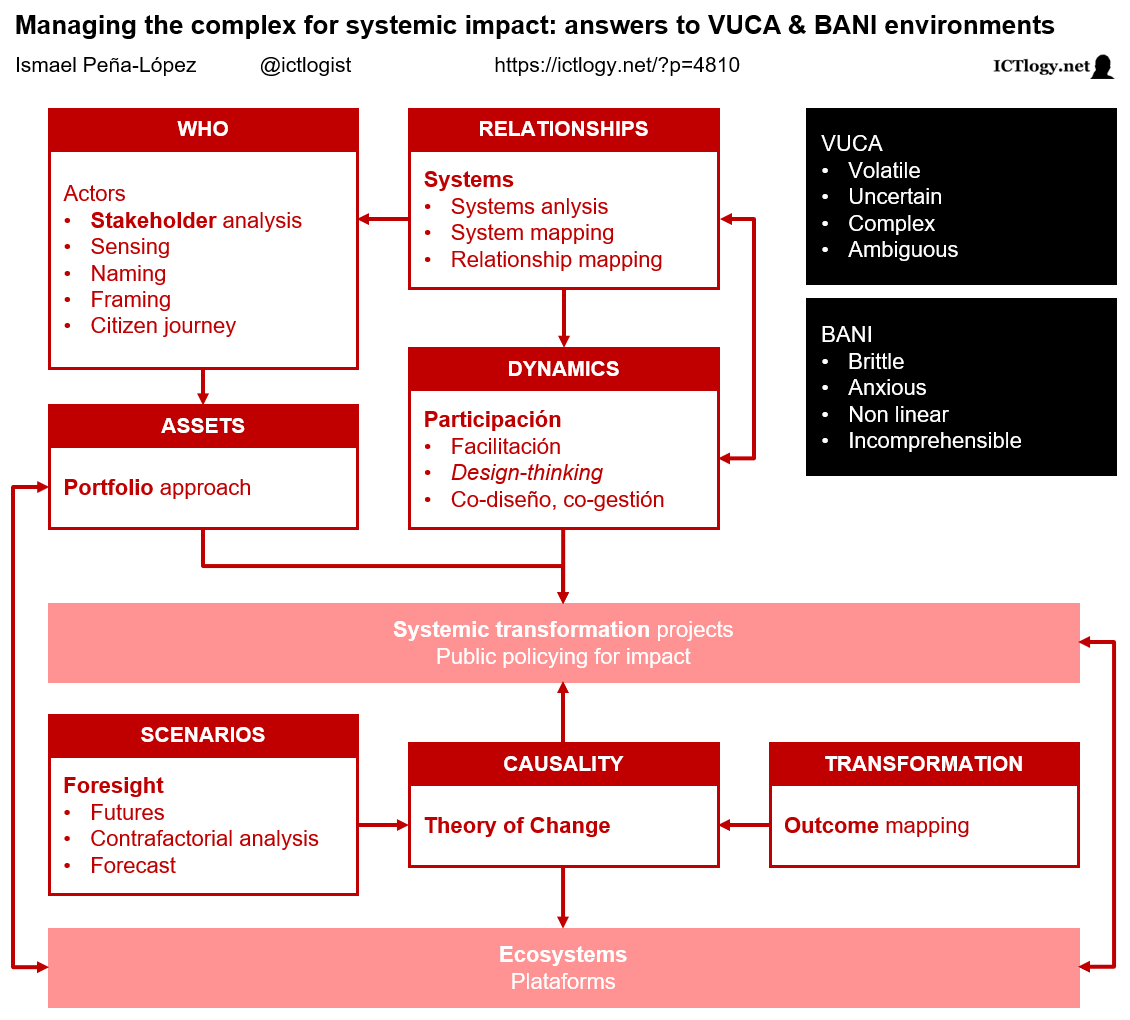
In recent decades, the acronyms VUCA and, more recently, BANI have become popular to describe the environments in which we live and work. But, beyond describing the situation or environment as VUCA or BANI, can we do anything about it? How can we change our way of managing projects or promoting impactful public policies? We have compiled below a set of emerging methodologies that allow us to move from theory to practice, from fear to action.
Table of contents
New environments: VUCA & BANI
VUCA
VUCA appears with the end of the Cold War, with globalization, with the digital revolution, with the financialization of the Economy. Adapting theories on leadership from Warren Bennis and Burt Nanus, it proposes that we increasingly operate in environments:
- Volatile: the dynamics of change are accelerated and the stages of the situations are short-lived;
- Uncertain: it is increasingly difficult to predict the future (and science must adapt to post-normality);
- Complex: where the causal relationships of a phenomenon are multiple and even impossible to define;
- Ambiguous: since it is difficult to make categorical statements, especially independent of each different situation or context.
BANI
Impacted by the COVID-19 pandemic, Jamais Cascio proposes in Facing the Age of Chaos to go beyond the definition of VUCA environments and suggests the BANI framework instead:
- Brittle: due to the extreme delicacy and contingency of situations, which can change quickly and drastically as a result of any cause;
- Anxious: in the sense that situations increasingly generate anxiety (due to the difficulty of dealing with them, due to the scope and depth of their impacts);
- Non-linear: due to the apparent disconnection, in direction and magnitude, between causes and consequences;
- Incomprehensible: since it is increasingly difficult to understand not only the causes but the very phenomena that we face.
Managing complexity for systemic impact
If the management of organizations, the fostering of public policies or the deployment of development (cooperation) projects follow one another in a practically deterministic way (if I do A, then B will happen) and a linearly way (few variables, always in a single direction), as environments grow in complexity, project management and impact public policies should also change.
With the management of complexity, new methodologies and approaches to management appear that incorporate three factors that were not always taken into account in traditional management, all of them related to the loss of control over the situation:
- Multifactoriality: realization and acknowledgement that there are many factors (particularly actors) that we do not control or even do not know, but that must be taken into account in the design as far as possible.
- Importance of design: since we cannot act arbitrarily or discretionally due to loss of control over factors, we try to control the playing field or, at the very least, to know it. Thus, the thoroughness on the design of the projects and the exhaustive knowledge of the environment are key.
- Influencing the system: although it may seem contradictory, since we are neither able to control nor often know the causal relationships, many projects will influence changing the system itself and will not limit themselves to operating within the system itself. The system becomes a dependent variable on which we can influence, not a variable that is given and to which we have to adjust.
Below we list some methodologies, approaches, concepts —with a more descriptive than normative goal— that incorporate new factors and perspectives to address the growing complexity in project management and public policies.
After each epigraph, a link “Some references on…” is added, which leads to a personal collection of documents that delve into the subject matter (on various occasions some documents are referenced in more than one epigraph when dealing with more than one topic).
Stakeholder analysis, naming, sensing, framing
The first major, necessary, incorporation of complexity is that of who, which actors intervene or are affected by an issue, a problem, a decision, a public policy. It does so through various names, each one with its particularities, the most common being the actor mapping and stakeholder analysis, but also interest groups and other denominations.
It is important to highlight that it is not only about making an inventory of actors, but also about how they read reality from their particular point of view. For instance, the question of housing has different readings and names depending on the actor: the problem of evictions, mortgages, rents, squatting, occupation mafias, immigration mafias, gentrification, tourist apartments, financial speculation, financialization of the economy, etc.
If we want to find solutions, we have to refine the diagnosis, and this involves incorporating all the different visions —without prejudices or moral judgments. How we “listen” to these actors —in Open Government we would speak of active listening— will be essential for the incorporation of all these visions.
Systems (systems analysis)
In the same way that it is done with actors, systems analysis tries to break down a complex problem into its basic components and processes, delimiting tasks, functions, relationships, direction of said relationships, etc.
Of course, systems analysis and stakeholder analysis are closely related, although while the latter is more focused on the subjects, the former is focused on their respective functions and interrelationships.
Systems analysis will provide better operational planning, improved ability to design and to implement better focused devices and assigning them the necessary resources (people, time, materials) to promote the components and functions that we want to leverage.
Foresight, futures
Foresight exercises are not new. “Foreseeing the future” —in the sense of considering what scenarios may occur in the future and with what probability— has been an exercise that humanity has carried out recurrently over the centuries.
However, the study of futures goes beyond mere prospective, for at least three reasons:
- For the abandonment of the hegemony of traditional statistics and the incorporation of post-normal science, which requires radical new approaches to the approach of what can happen and why.
- For to the incorporation of new actors and functions and the creation of new scenarios. In other words, and related to the previous points, it is not only a question of foreseeing what can happen, but of capturing what these future scenarios can be like, beyond whether they are possible and to what extent.
- For to the formation of new realities at the same time that we think about them, along the lines of what was previously commented on taking the system as an endogenous variable: futures exercises are often not only inventories of what can happen but also of what we would like to happen —and, as we will see later, what would have to be done to make them possible and probable.
Outcome mapping
Out of all the possible scenarios, outcome mapping helps us identify the effects we want to see happen. The concept of outcome is sometimes confusing and used interchangeably as effect or impact. Strictly speaking, in the activities we carry out, three stages of “impacts” can be distinguished:
- Output, result: the “thing” (good, service) that we have produced and that is under our control. E.g. a basic digital literacy course.
- Outcome, effect: the intermediate changes, in the short term, in which we have been able to influence directly. E.g. improve the ICT competence of some people.
- Impact, impact: structural changes (behaviors, visions of reality, etc.), in the long term in which we can influence indirectly but to which we ultimately aspire. E.g. improve the employability of a collective.
Outcome mapping focuses the analysis on those effects that we can influence and that are real changes in a situation. They force us to think (and design) for impact, for transformation, avoiding “solutions” whose results are an investment of resources without impact on the system.
Theory of Change
The Theory of Change is linked to outcome mapping and tries to find the causal relationships that lead to impact, what we can do to obtain a certain result or impact. The Theory of Change identifies the necessary resources to carry out activities that will have expected results controllable to a certain extent; and, based on these results, and the causal relationships inferred or found by experimentation, expect to be able to influence directly to achieve effects and, indirectly, to achieve results, impacts.
The Theory of Change, like any theory, must be validated and, for this, evaluated. In the Theory of Change, evaluation (measurement, verification, ratification or refutation) is fundamental and forms part of the various iterations of the implementation of the Theory of Change.
It is important to note that the Theory of Change, like the very definition of results, effects and impacts, is very circumstantial or contextual: there are intermediate effects that are impacts at another level of analysis and vice versa: impacts that, at another level, are mere results, that can lead to other higher impacts.
Portfolio-based approach
The portfolio-based approach is situated (conceptually) halfway between stakeholder analysis, systems analysis and the Theory of Change. If we admit that we do not have control over everything, and that we need to mobilize certain resources to achieve certain results, we need to know what assets we all have together and how we can align them to achieve a common goal.
Going back to the Open Government paradigm, it is about acknowledging, from this map of actors, how each one participates in the project, but not only with their vision, but also and above all, with their own contributions (materials, methodologies, etc.).
To some extent, the portfolio-based approach challenges the foundations of classical organizational theory: counting on resources that “are not yours.” But, with the appropriate strategy, they can be mobilized and aligned for the common objective. For this reason, this approach fits into the entire complexity management map, where actors, relationships, scenarios and causal relationships have an architecture that is so different from classical management by processes.
Participation, facilitation, design thinking
Faced with this great organizational complexity, how we implement it comes to the forefront, even coming before the planning itself, at least the operational one.
The participation of the actors in the processes of diagnosis, deliberation, negotiation, decision-making or evaluation becomes essential; and the facilitation and revitalization of these participation processes to achieve the objectives, so that participation is efficient and effective. Of course, the logic with which it is created (or co-created, and later co-managed) requires new design methodologies: design-thinking , agile methodologies and others are now incorporated into the toolbox to enhance it.
Ecosystems
Recently the concept of ecosystem has jumped from the realm of biology to that of technology, and from there to that of the social sciences. In a first meaning outside the field of life sciences, we speak of the ecosystem approach characterized by global vision, comprehensive action. It is a first meaning, but when we talk about governance ecosystems (of projects, of policies), the concept goes much further —going beyond what, in fact, could be assimilated to the vision of the system that we saw previously.
When we talk about acting with an ecosystem approach, we admit that its complexity often does not allow direct action. We saw it when talking about the multiplicity of actors, their relationships, their respective portfolios, how they co-design actions or align themselves with them, the multiplicity of scenarios and desirable results and impacts, the difficulty of establishing relationships causes over which we have no control (only influence, often indirectly). Given this scenario, the ecosystem vision is characterized, in addition to the global vision and comprehensive action, by:
- Act on the environment, on the context, to influence (indirectly) the results, effects and impacts. This is done by providing the generic infrastructure of the ecosystem.
- Promote the autonomy of the actors, providing transversal applications (methodologies, instruments, resources, codes, standards) that they can use freely.
- Align the different autonomous instances (projects, institutions) of the actors through the design of the infrastructure and transversal applications, promptly providing incentives that reward alignment or penalize (or leave rewardless) divergence.
The ecosystem vision, therefore, promotes the project or the institution as a platform on which others operate, where institutions and projects become open infrastructures for autonomous decision-making with collective impact.
In conclusion, the way of approaching projects, the management of organizations or the promotion of public policies is changing radically as a result of the verification of the profound (and constant and accelerated) transformation of the contexts and environments in which these take place. and they operate.
There is no single model, and often the methodological proposals are heterogeneous, from what are mere descriptions to highly complex organizational and operating architectures. However, all of them seek to overcome a way of designing and managing that shows many signs of fatigue, insufficiency, and inefficiency. For now —and, perhaps, for a long time— it will be necessary to arm ourselves with a new toolbox, profiles and skills to perform new tasks and tackle new challenges and try to provide solutions, always incomplete, always tentative, always temporary, but always also necessary to influence the environment, in the context, to, through these, progress.