By Ismael Peña-López (@ictlogist), 17 March 2009
Main categories: Digital Literacy
Other tags: crossmedia, Digital Literacy, e-awareness, e-competences, e-skills, media literacy, multimedia
25 Comments »
Digital literacy (or digital literacies), e-skills, e-competences, skills for the Information Society, etc. There is plenty of literature about digital literacy in a broad sense. And there are even as many names as works to describe concepts, similar one to each other, but with shades and subtleties that make them have yet different meanings.
In my opinion, two problems are both the cause and the consequence of this lack of understanding, closely bound one to the other one.
The first one is that, most usually, digital skills are looked at at a very micro level. For instance, the most instrumental digital literacy (i.e. technological literacy) can be described without taking into account informational literacy, personal knowledge management, the sociocultural framework and so.
The second one is that, almost always, digital skills are not taken dynamically, but as a pretty static, closed black box. Take media literacy as an example, where a (for me) necessary corollary to the acquisition and mastering of instrumental multimedia skills should be followed by reflections on the change of the Fourth Estate, the rise of the Fifth Estate and so.
Actually, it is especially this last part, the dynamics of digital literacy and its actual application to everyday life — education, work, leisure, politics, social engagement — the most interesting to me and, to my knowledge, the most unattended one.
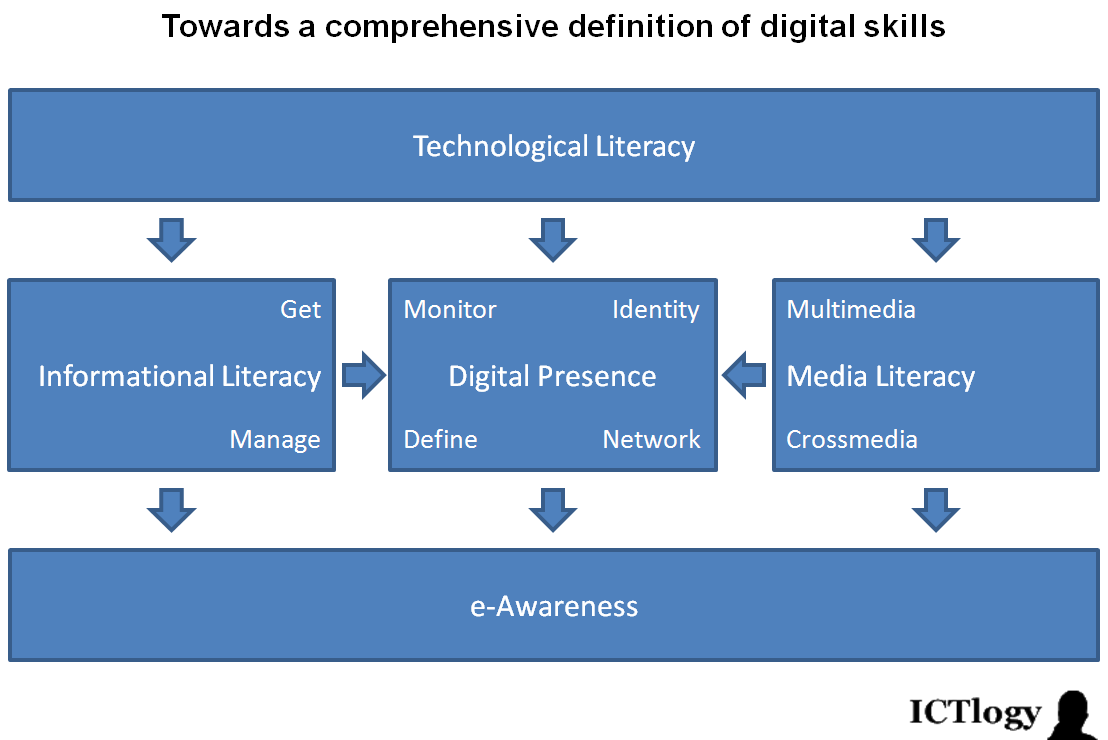
Had I to picture such dynamics, I would do it this way:
Where concepts are:
- Technological Literacy: the skills to interact with hardware and software
- Informational Literacy: the competences to deal with information, normally by means of ICTs (applying Technological Literacy). We could draw here two stages: a more instrumental one, related on how to get (relevant) information, and a more strategic one related to how to manage that information (or knowledge, if we speak of personal knowledge management)
- Media Literacy: skills and competences to deal with several media, make them interact and integrate them in a single output. I believe we could also draw a lower level, multimedia, where interaction would be more mechanical, and a higher one, crossmedia, where interaction and integration respond not to technical possibilities but to a strategic design, building an ecosystem of different media (and not a simple multimedia output)
- Digital Presence: Is centred in the person. These are the digital skills to monitor and establish a digital identity, and the skills to actively define it and use it for networking or interacting with other people digitally
- e-Awareness: the most strategic (even philosophical) stage is the one related with being aware on how the world and our position — as a person, group, firm, institution — varies because of digital technologies
These concepts can be rephrased as:
- Technological Literacy: HOW
- Informational Literacy: WHAT
- Media Literacy: WHERE
- Digital Presence: WHO
- e-Awareness: WHY
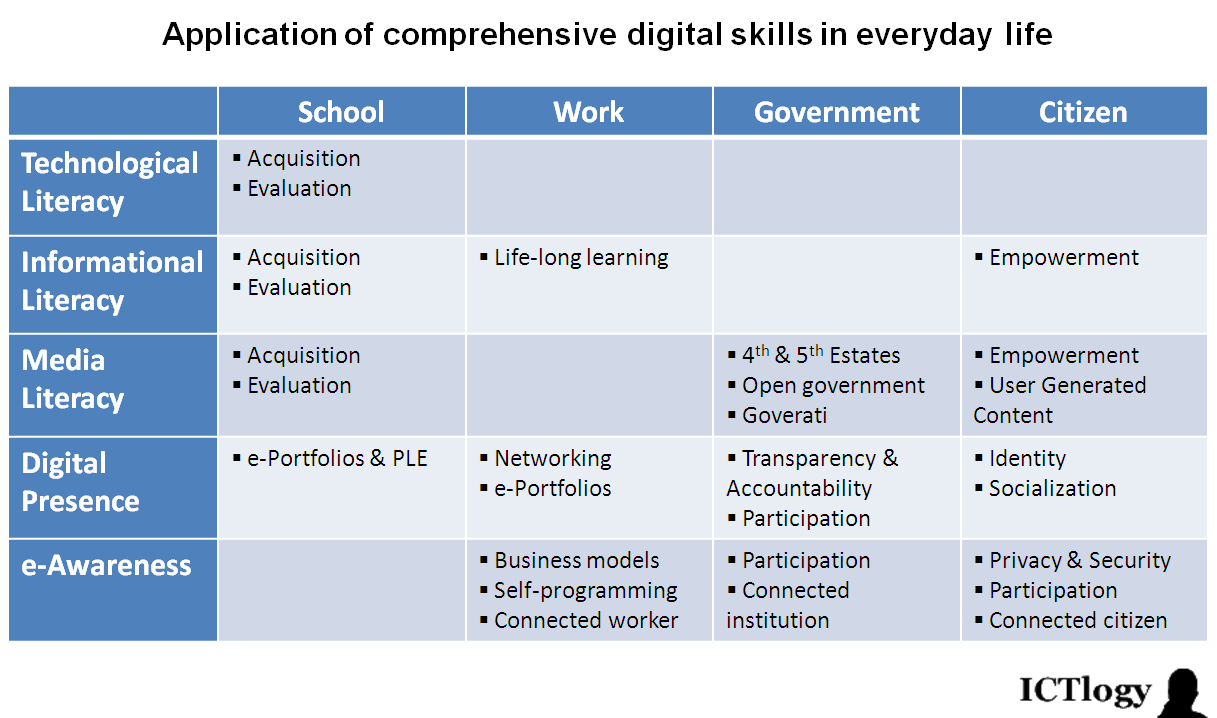
Some examples on what these digital skills and competences mean in everyday life are as follows:
The approach above is completely exploratory and fails to be complete. It is, though, a reflection of what I sense is happening at the applied level, when sometimes too much conceptual figures have to be put to work at home, in the school, at work or social and political engagement. In other words, how do we put the tools — and problems, and questions — of the Information Society in the hands of leaders, decision-takers and policy-makers.
We need not static frames, but dynamic paths. From 0 to 100. From the simplest needs to the deepest understanding. And build bridges amongst them stages.
By Ismael Peña-López (@ictlogist), 11 March 2009
Main categories: Digital Divide, Digital Literacy, e-Government, e-Administration, Politics, Education & e-Learning, ICT4D, Meetings, Participation, Engagement, Use, Activism
Other tags: idpac, UNDP
No Comments »
The Escuela Virtual para América Latina y el Caribe (Virtual school for Latin America and the Caribbean) is an organization (depending from the UNDP) whose mission is to build capacity and impart training in the fields that can promote social transformation, namely human development and democratic governance. As its name reads, it is a fully online school and uses ICTs as a means; but it is also worth noting that the Virtual School is in itself a showcase on how to apply ICTs in Development (ICT4D), specially in what we’d call e-Learning for development.
A successful project, it is now in its way to train other organizations not only in their missionary content, but also in the “how to” part of the story: how to build up a virtual school (for government, for empowerment) in Latin America. These days (10th to 12th March 2009) it’s taking place a training-consultancy for people at the Instituto Distrital de Participación y Acción Comunal de la Secretaría de Gobierno de la Alcaldía de Bogotá (IDPAC: Participation and Community Building Institute at Bogotá, Colombia), so that they can build their own Virtual School of Local Participation.
I have been invited to give a conference on e-Learning for Development, entitled La Brecha digital y el uso de las TIC para la Educación (The Digital Divide and ICTs for Education).
The presentation has four different parts:
- Slides 1-6: A brief introduction and some highlights about the crossroads between participation, governance, human rights and the changes that the Information Society is bringing in. The topic just frames my introductory presentation, and is later on developed in depth by professor Jaime Torres, Universidad de los Andes.
- Slides 7-12: Second part is a characterization of the Digital Divide. It actually is about the digital divides, which is absolutely my point: there are many of them, and most of them usually kept out of the spotlight.
- Slides 13-21: Third part is about networks. It is focused in development and development cooperation. There’ll be time to explore online volunteering, development 2.0, the gift economy, etc.
- Slides 22-31: A last part is about (how great it is) e-learning for development issues, from different points of view: efficacy, efficiency, suitability, convenience, etc.
Citation and downloads: La Brecha digital y el uso de las TIC para la Educación.
I want to thank Andoni Maldonado and Gemma Xarles for their kind invitation, and to Nicolás Padilla for assistance and patience.
By Ismael Peña-López (@ictlogist), 03 March 2009
Main categories: Digital Divide, e-Readiness, ICT4D
Other tags: icd_development_index, idi, itu
2 Comments »
The International Telecommunication Union has published their new ICT Development Index, measuring 11 Information and Communication Technologies indicators for 154 countries, and calculating its value for 2002 and 2007, so that comparisons can be made available.
The ICT Development Index (IDI) is a merger of two previous indices: the Digital Opportunity Index and the ICT Opportunity Index. From the DOI it takes indicators related to households and broadband and the methodology and presentation, while from the ICT-OI it takes indicators related to skills, the normalization method and the digital divide analysis and methodology.
This merger responds to the proposal — and need — of the ITU and other international agencies to concentrate all efforts in just one multi-purpose measuring device, instead of having several complementing indices fostered by different organizations. So we should congratulate all agencies contributing to making this possible for that effort.
But. While some consensus has been reached, the cost of is that the new index has evolved towards a lowest common denominator. In our opinion, losing the information that affordability brought to i.e. the DAI is a loss of shades that were of most utility. This way, the new index is more polarized and is mainly intensive in infrastructures and just shyly on usage and skills, leaving a big void in all other aspects of digital life: the ICT sector, digital skills (the new index uses but proxies) or the legal framework.
On the other hand, the most interesting thing to highlight from this index is that, unlike most other indices, the coefficients of the weigths assigned to each indicator and subindex are calculated statistically, using principal components analysis. Undoubtedly, this provides much legitimacy to the final index values, at least at the formal level.
To clarify the evolution within the UN Sytem of how ICTs have been measured we have prepared the following scheme:
More brief information related to these indices can bee accessed in the following links:
More information
Note: I want to thank Ivan Vallejo from the ITU for his quick and effective answer to my requirement. ¡Gracias!


 , 1.54 MB)
