
e-Learning for Development: a model
Works included in my DEA (Masters Thesis), Spring 2005: Peña-López, I. (2005). e-Learning for Development: a model. ICTlogy Working Paper Series, #1. Barcelona: ICTlogy.
- Development, Social Services
- Digital Divide
- Digital Inclusion
- Digital Literacy
- e-Learning and Instructional Technology
- e-Readiness
- Economics
- Education
- FLOSSE
- Free Software
- History
- ICT Infrastructure
- ICT4D
- Information Society
- Innovation
- Knowledge Management
- Nonprofits
- NPTech
- Online Volunteering
- Open Access
- Policy & Regulation
- Social Media & Social Software
- Teleworking
Bibliography for a/an: PhD Thesis
Listing 85 references:
ABC Nuevo Trabajo . Madrid: ABC.
Acevedo, M. (2004). “Las TIC en las políticas de cooperación al desarrollo: hacia una nueva concepción en la Sociedad Red”. In Ingeniería Sin Fronteras (Ed.),
Cuadernos Internacionales de Tecnología para el Desarrollo Humano, noviembre 2004, 43-54, (2). Retrieved December 10, 2004 from http://www.cuadernos.tpdh.org/file_upload/02_Manuel_Aceved.pdf
Amatriain, X. (2004). Free software in education: a guide for its justification and implementation. Retrieved May 05, 2005 from http://www.iua.upf.es/~xamat/FreeSoftware/FreeSoftwareEducation.pdf
Arina, T. (2005). Future of FLOSSE. Espoo: Ionstream Oy / Dicole. Retrieved May 11, 2005 from http://flosse.dicole.org/media/documents/Future_of_FLOSSE-Results.pdf
Babot, I. (2003). e-Learning, corporate learning. Barcelona: Gestión 2000.
Bates, T. (2005). Why e-learning has failed - and why it will succeed. Conference given at UOC February 3, 2005. Barcelona: Tony Bates Associates Ltd..
Baumgartner, P. (2005). “How to choose a Content Management Tool according to a Learning Model”. In
elearningeuropa.info, 17 May 2005. Brussels: European Commission. Retrieved May 23, 2005 from http://www.elearningeuropa.info/en/article/How-to-choose-a-Content-Management-Tool-according-to-a-Learning-Model
Canals, A. (2003). Gestión del conocimiento. Barcelona: Gestión 2000.
Castells, M. (2002). La Galàxia Internet: Reflexions sobre Internet, empresa i societat. Barcelona: Rosa dels Vents.
Coordinadora de ONG para el Desarrollo - España (2005). Informe de la CONGDE sobre el sector de las ONGD 2004. Madrid: CONGDE. Retrieved June 09, 2005 from http://www.congde.org/CONGDE2004.pdf
Coppola, C. & Neelley, E. (2004). Open Source Opens Learning. Phoenix: The r·smart Group. Retrieved September 13, 2004 from http://www.rsmart.com/assets/OpenSourceOpensLearningJuly2004.pdf
Cornella, A. (2003). Hacia la empresa en red. Barcelona: Gestión 2000.
Correa, C.M. (2005). “How intellectual property rights can obstruct progress”. In
SciDev.Net, 4 April 2005. London: SciDev.Net. Retrieved May 25, 2005 from http://www.scidev.net/dossiers/index.cfm?fuseaction=dossierreaditem&dossier=13&type=3&itemid=375&language=1
Cravens, J. (2005). Myths About Online Volunteering. Retrieved May 09, 2005 from http://www.coyotecommunications.com/volunteer/ovmyths.html
Creative Commons (2005). About Us. San Francisco: Creative Commons. Retrieved June 15, 2005 from http://creativecommons.org/about/history
Creative Commons (2005). Licenses Explained. San Francisco: Creative Commons. Retrieved March 12, 2005 from http://creativecommons.org/about/licenses/
Daly, J.A. (2003). “Volunteers, Information and Communication Technologies and Development”. In
The Development Gateway. Washington DC: The World Bank. Retrieved November 17, 2003 from http://www.developmentgateway.org/download/218111/VOLUNTEERING.doc
Downes, S. (2004). Emerging Technologies in E-Learning. Moncton: Stephen Downes. Retrieved March 17, 2004 from http://www.downes.ca/files/Emerging.ppt
Downes, S. (2005). The Living Arts: The Future of Learning Online. Moncton: Stephen Downes. Retrieved May 30, 2005 from http://www.downes.ca/files/guelph.ppt
ELIT Learning Innovation (2002). Gestión del Conocimiento. Barcelona: Universitat Oberta de Catalunya.
Franco, C. (Coord.) (2002). ¿Conectadas? Las ONG Españolas en la red. Barcelona: Fundació Un Sòl Món.
Free Software Foundation (2001). What is Copyleft?. Retrieved March 12, 2005 from http://www.gnu.org/copyleft/copyleft.html
Free Software Foundation (2004). Licenses. Retrieved March 12, 2005 from http://www.gnu.org/licenses/licenses.html
Gibbons, A.S., Nelson, J. & Richards, R. (2000). “The nature and origin of instructional objects”. In Wiley, D.A. (Ed.),
The Instructional Use of Learning Objects: Online Version. Retrieved June 07, 2004 from http://reusability.org/read/chapters/gibbons.do
Google (2005). Technology. Mountain View: Google. Retrieved May 01, 2005 from http://www.google.com/technology/
Gur, B. & Wiley, D.A. (2005). “Code as Ideology”. In
Iterating Toward Openness, Friday, March 4th, 2005. Retrieved May 16, 2007 from http://opencontent.org/blog/archives/18
Hawkins, R.J. (2002). “Ten Lessons for ICT and Education in the Developing World”. In Kirkman, G., Cornelius, P.K., Sachs, J.D. & Schwab, K. (Eds.),
Global Information Technology Report 2001-2002: Readiness for the Networked World.
Heeks, R. (2005). “ICTs and the MDGs: On the Wrong Track?”. In i4d,
i4d - Information for Development, Vol. III No.3 February 2005. Retrieved February 22, 2005 from http://www.i4donline.net/feb05/feb05.pdf
Himanen, P. (2003). L'ètica hacker i l’esperit de l’era de la informació. Barcelona: Editorial UOC.
ICTlogy . Barcelona: Ismael Peña-López. http://review.ictlogy.net
International Institute for Educational Planning (2004). Free and Open Source Software for e-learning. Background Note for the Discussion forum 1-25 June 2004. Paris: UNESCO-IIEP.
ISOPH (2004). e-Learning in Nonprofits and Associations. Washington: ISOPH.
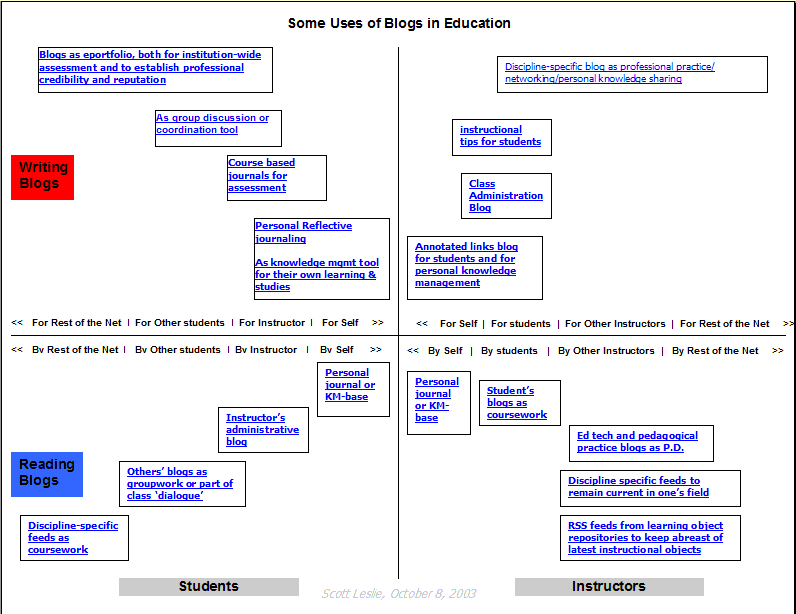
Leslie, S. (2003). “Some Uses of Blogs in Education”. In
EdTechPost, October 8th, 2003. Retrieved April 03, 2005 from http://www.edtechpost.ca/gems/matrix2.gif
Lessig, L. (2004). Free Culture. New York: The Penguin Press.
Margulies, A.H. (2004). The OpenCourseWare Initiative A New Model for Sharing. Boston: MIT World. Retrieved July 09, 2004 from http://mitworld.mit.edu/play/206/
Mas, J. (2005). Software libre: técnicamente viable, económicamente sostenible y socialmente justo. Barcelona: Gestión 2000.
McGovern, P. (2004). SourceForge.net. Retrieved April 05, 2005 from http://www.lugod.org/presentations/history-sourceforge.pdf
Monge Benito, S. (2003). ¿Es aplicable el modelo de producción del software libre a contenidos educativos?. Leioa: Universidad del País Vasco. Retrieved October 27, 2004 from http://spdece.uah.es/papers/Monge_Final.pdf
Moyle, K. (2004). Total Cost of Ownership and Open Source Software. Mount Gambier East: Grant High School. Retrieved May 11, 2005 from http://www.e-learning.sa.edu.au/elearning/files/links/Executive_Summary_TCO_and.pdf
Murrain, M. (2004). Choosing and using open source software: A primer for nonprofits. Washington: NOSI. Retrieved March 17, 2005 from http://www.nosi.net/primer
Murray, V. & Harrison, Y. (2002). Virtual Volunteering: Current Status and Future Prospects. Toronto: Canadian Centre for Philanthropy. Retrieved May 30, 2005 from http://www.nonprofitscan.ca/pdf/SR/Murray-SR2-English-Web.pdf
Nicol, C. (Ed.) (2003). ICT Policy: A Beginner ’s Handbook. Johannesburg: Association for Progressive Communications. Retrieved December 18, 2003 from http://www.apc.org/books/policy_handbook_EN.zip
Nilles, J. (1998). Some Common —and Not So Common— Telework/Telecommuting Questions. Los Angeles: Jala International, Inc.. Retrieved April 21, 2005 from http://www.jala.com/faq.php
Npower (2001). Technology Literacy Benchmarks for Non-Profit Organizations. Seattle: Npower.
Npower (2004). Education Services. Seattle: Npower. Retrieved May 02, 2005 from http://www.npower.org/npowerservices/nationalprojects/final+education-hr.pdf
OECD (2004). CRS purpose codes. Paris: OCDE. Retrieved June 14, 2005 from http://www.oecd.org/dataoecd/41/1/6517133.xls
Ortoll Espinet, E. (Coord.) (2005). Alfabetització i exclusió digital. Barcelona: Universitat Oberta de Catalunya.
Papathéodorou, A. (2000). “Tous experts! Des Réseaux d'échange de Savoirs Techno-Scientifiques”. In Association Multitudes,
Multitudes, numéro 3, novembre 2000. Paris: Editions Exils. Retrieved May 05, 2005 from http://multitudes.samizdat.net/article.php3?id_article=151
Peña-López, I. (2001). La coordinación y el trabajo en red. Gestión de las ONG, proyectos y formación webcéntricos: el Campus for Peace. Barcelona: UOC. Retrieved May 01, 2005 from http://www.uoc.edu/web/esp/art/uoc/pena1201/pena1201.html
Peña-López, I. (2002). “Cooperación y Voluntariado en red y en la Red”. In
Documentación Social, Trabajo en Red, (129), 187-203.
Peña-López, I. (2004). “Voluntariado Virtual para e-Learning Solidario”. In
ICTlogy, March 2004, (6). Retrieved December 23, 2004 from https://ictlogy.net/articles/20040611_www.ictlogy.net_online_volunteering_elearning_esp.pdf
Peña-López, I. (2005). “Four types of online volunteering”. In
ICTlogy, January 2005, (16). Retrieved February 20, 2005 from https://ictlogy.net/review/?p=207
Peña-López, I. (2006). “World Telecommunication/ICT Development Report 2006: digital divide narrowing?”. In
ICTlogy, May 2006, (32). Retrieved November 02, 2006 from https://ictlogy.net/review/?p=402
Reynolds, R. (2003). Open Source Courseware. Evaluation and Rating. Retrieved April 25, 2003 from http://www.xplana.com/whitepapers/archives/Open_Source_Courseware
Siemens, G. (2003). “Free and Open Source Movements”. In Siemens, G.,
elearnspace, March 3, 2003. Retrieved May 11, 2005 from http://www.elearnspace.org/Articles/open_source_part_1.htm
Siemens, G. (2003). “Open Source Content in Education”. In Siemens, G.,
elearnspace, March 10, 2003. Retrieved May 11, 2005 from http://www.elearnspace.org/Articles/open_source_part_2.htm
Stallman, R.M. (2002). Free Software, Free Society: Selected Essays of Richard M. Stallman (Edited by Joshua Gay). Boston: GNU Press.
Suber, P. (2003). Guide to the Open Access Movement (formerly Guide to the FOS Movement). Retrieved June 18, 2005 from http://www.earlham.edu/~peters/fos/guide.htm
Suber, P. (2005). Open Access Overview. Retrieved April 28, 2005 from http://www.earlham.edu/~peters/fos/overview.htm
Tong, T.W. (2004). Free-Open Source Software in Education. Kuala Lumpur: UNDP-APDIP. Retrieved October 27, 2004 from http://www.iosn.net/education/foss-education-primer/fossPrimer-Education.pdf
Trucano, M. (2005). Knowledge Maps: ICTs in Education. Washington, DC: infoDev. Retrieved April 25, 2005 from http://www.infodev.org/files/1062_file_KnowledgeMaps_ICTs_and_the_Education_MDGs.pdf
UNCTAD (2006). Using ICTs to Achieve Growth and Development. Background paper by the UNCTAD secretariat. Geneva: UNCTAD. Retrieved February 28, 2007 from http://www.unctad.org/en/docs/c3em29d2_en.pdf
UNDP (2001). Human Development Report 2001. Making New Technologies Work for Human Development. New York: UNDP. Retrieved September 03, 2008 from http://hdr.undp.org/en/media/completenew1.pdf
UNDP (2004). Human Development Report 2004. Cultural liberty in today’s diverse world. New York: UNDP. Retrieved December 16, 2004 from http://hdr.undp.org/reports/global/2004/pdf/hdr04_complete.pdf
UNDP (2006). Human Development Report 2006. Beyond scarcity: Power, poverty and the global water crisis. New York: UNDP. Retrieved November 30, 2006 from http://hdr.undp.org/hdr2006/pdfs/report/HDR06-complete.pdf
UNDP (2006). Human Development Report 2007/2008. Fighting Climate Change: Human solidarity in a divided world. New York: UNDP. Retrieved November 30, 2006 from http://hdr.undp.org/en/reports/global/hdr2007-2008/
United Nations ICT Task Force (2003). Tools for Development: Using Information and Communications Technology to Achieve the Millennium Development Goals. Working paper for WSIS. Geneva: UNICTTF.
United Nations Volunteers (2004). Online Volunteering: Nothing Virtual About It!. Bonn: UNV.
Warschauer, M. (2002). “Reconceptualizing the Digital Divide”. In
First Monday, 7 (7). Retrieved May 10, 2005 from http://firstmonday.org/issues/issue7_7/warschauer/index.html
Warschauer, M. (2003). “Demystifying the Digital Divide”. In Scientific American, Inc.,
ScientificAmerican.com, august 2003. Retrieved May 10, 2005 from http://www.sciam.com/article.cfm?chanID=sa006&colID=1&articleID=000112F0-AB93-1F09-97AE80A84189EEDF
Wiley, D.A. (2000). “Connecting learning objects to instructional design theory: A definition, a metaphor, and a taxonomy”. In Wiley, D.A. (Ed.),
The Instructional Use of Learning Objects: Online Version. Retrieved June 07, 2004 from http://reusability.org/read/chapters/wiley.doc
Wiley, D.A. (Ed.) (2000). The Instructional Use of Learning Objects: Online Version. Retrieved June 07, 2004 from http://reusability.org/read/
Williams, M. (2008). Broadband for Africa: Policy for Promoting the Development of Backbone Networks. Washington, DC: infoDev. Retrieved August 09, 2008 from http://www.infodev.org/en/Document.526.aspx
Wilson, S. (2005). “Distributed engagement with courses and other units of learning”. In Wilson, S.,
Scott's Workblog, January 25th, 2005. Retrieved April 03, 2005 from http://www.cetis.ac.uk/members/scott/entries/20050210014657
Wilson, S. (2005). “Future VLE - The Visual Vision”. In Wilson, S.,
Scott's Workblog, January 25th, 2005. Retrieved April 03, 2005 from http://www.cetis.ac.uk/members/scott/entries/20050125170206
Wilson, S. (2005). “The VLE of the Future”. In Wilson, S.,
Scott's Workblog, January 17th, 2005. Retrieved April 03, 2005 from http://www.cetis.ac.uk/members/scott/entries/20050117150356
WSIS Executive Secretariat (Ed.) (2003). World Summit on the Information Society - Declaration of Principles. Geneva: ITU. Retrieved December 21, 2003 from http://www.itu.int/dms_pub/itu-s/md/03/wsis/doc/S03-WSIS-DOC-0004!!MSW-E.doc
WSIS Executive Secretariat (Ed.) (2003). World Summit on the Information Society - Plan of Action. Geneva: ITU. Retrieved December 21, 2003 from http://www.itu.int/dms_pub/itu-s/md/03/wsis/doc/S03-WSIS-DOC-0005!!MSW-E.doc
WSIS Executive Secretariat (Ed.) (2004). World Summit on the Information Society - Report of the Geneva phase of the WSIS. Geneva: ITU. Retrieved March 21, 2004 from http://www.itu.int/dms_pub/itu-s/md/03/wsis/doc/S03-WSIS-DOC-0009!R1!MSW-E.doc
WSIS Executive Secretariat (Ed.) (2006). Basic Information About WSIS. Geneva: ITU. Retrieved March 14, 2008 from http://www.itu.int/wsis/basic/about.html
Zondergeld, S. (2004). First Inventory: eLearning and Open Source Software (OSS) Projects in Europe. Retrieved May 14, 2005 from http://www.ossite.org/activities/firstinventory/view
Zugaldia, A. (2004). Software Libre: Desarrollo y Paz. Granada: gcubo.org. Retrieved April 26, 2005 from http://www.ugr.es/~az/eirene/eirene.pdf