By Ismael Peña-López (@ictlogist), 09 September 2008
Main categories: ICT4D
Other tags: Florence N Kivunike, Henrik Hanson, ict4d_symposium_2008, Peter Mozelius, phd, Postma Louise, Raimo Haapakorpi, Uduak Okon
1 Comment »
Notes from the IPID ICT4D PG symposium 2008, Mekrijärvi Research Station, Joensuu University, Finland. 8 and 9 September, 2008.
SWOT methodology to analyse the work of an ICT director in a Tanzanian university.
Some of the strengths/weaknesses are based on cultural issue. Sometimes highest (personal) commitment is not liked to the sufficient knowledge to achieve some specific goals. And while strong opportunities seem to be coming in the horizon because of the deployment of ITs and IT training, loss of key staff and the cost of management are threats to be seriously taken into account.
How to motivate IT professionals… and retain skilled ones in the country, avoiding them to get away to more appealing professional opportunities?
Jan Mosander (2008) Pengarna Som Förnsvann. The money that disappeared, abuse of the Swedish aid (SIDA).
Worst practices:
- Investment in a local entrepreneur… that will take the production abroad.
- Engage in the restoration of a building without the local community being aware of it
- Telecenter with all facilities provided… but no means to maintain it (not even to pay the electricity)
Best practices:
- Technology adapted to the local needs and possibilities
- Clear business model, sustainable
- Find synergies with other local initiatives (e.g. telecentre + healthcare centre)
Shilpa Sayura telecentres in Sri Lanka:
- Enthusiasm
- Commitment
- Local ownership
- Government support
- Public-Private partnership
Conclusions
- Bottom-up approach
- In depth pre-study
- Partner commitment
- Local skilled coordinator
- Communication strategy
- Iterative monitoring
- Openness and flexibility
- Sustainability
Rural communities in developing countries: majority of the population, poor, isolated and based on farming.
Generic ICT4RD model: to increase the impact in rural communities through ICTs, mainly to alleviate poverty and isolation.
Findings
- Unintended, innovative use of personal/simpler ICT (mobile)
- Limited or no use of externally motivated ICT (computers, internet)
- Attributed to focus on the supply side, not in quality of life improvement
Need to go back to the roots and perfectly define what is quality of life: subjective, multidimensional:
- Cummins: Subjective Well Being Homeostasis (SWB), quality of life is maintained at a level of stability — Cummins, R.A. (2001). The subjective well-being of people caring for a severely disabled family member at home: A review. Journal of Intellectual and Developmental Disability, 26, 83-100.
- Amartya Sen: capability approach, development as freedom
Methodology: description — qualitative approach to refine indicators and concepts — quantitative approach to get proper data and perform analysis.
Participatory Action Research combined with Ethnography.
What is a ‘sustainable community’? Existing and future residents meet their needs, are sensitive to the environment and contribute to high quality of life… a ‘western’ definition difficult to apply in developing countries.
Methodology: redefining ‘community’ and ‘sustainability’; understanding the communicative ecology; engaging communities in critical dialogue.
‘New’ definition of sustainability: equal opportunities, standards of living…
‘New’ definition of community: geography, language, culture, social norms and values, collective responsibility, shared leadership…
Communicative ecologies (Tacchi and Slater): the complete range of communication media and information flows in a community.
How to empower faculty in a changing environment, where integration is needed?
The objective of the analysis will be how integration and debate can take place in virtual environments, heavily relying in Habermas in the sense that communication can be improved by avoiding distortions.
Textual and contextual analysis, to see how discourse is constructed — and distorted.
Third Annual ICT4D Postgraduate Symposium (2008)
By Ismael Peña-López (@ictlogist), 09 September 2008
Main categories: ICT4D
Other tags: ict4d_symposium_2008, Seugnet Blignaut
No Comments »
Notes from the IPID ICT4D PG symposium 2008, Mekrijärvi Research Station, Joensuu University, Finland. 8 and 9 September, 2008.
Keynote speech
Seugnet Blignaut: ICT development in South Africa, a comparison between Finland and South Africa using SITES 2006 project data
Sometimes education (specially syllabuses designed in the “North” for the “South”) do not takes into account everyday skills, skills and literacy used during daily tasks: reading, writing, numeracy skills, social skills, information literacy, communication, Internet browsing, etc.
So we have to design — as South Africa is doing right now — an e-Education Policy that aims at the achievement of such ICT or digital skills for everyday life. And a priority of this policy is equity: poverty and equal opportunities is a must.
SITES
SITES, fostered by the International Association for the Evaluation of Educational Achievement (IEA), studies measure the evident of impact of ICTs in education, based on a comparative international quantitative studies.
- How ICT affects learning and tgeaching in schools
- Is there any indication taht education policies make any impact on pedagogy
Main problems found in Module 1:
- Computers not connected to the Interent
- Lack of peripherals (e.g. printers)
- Licensed copies of software
- Teachers’ inadequate ICT knowledge and skills
Module 2 was more based on a constructivist approach, which means the design of surveys and activities followed this pedagogical model too.
Findings
- Major concern in preparing students to use the Internet “responsibly”
- Out of five, most countries score around 3.3 in ICT vision, connectedness,…
- Almost 100% of kids in the sampled schools had access to both a computer and the Internet
- But the student/computer ration varies within a wide range depending on country and even inside each country
- A majority of teachers believe they need more computers and, actually, more technology in general, as e.g. smartboards
There is content, there is technology… but it does not reach the non-initiated (non-geek) teacher. So more effort should be put not in creating more content or installing more infrastructures, but on making the existing ones more findable, known, accessible, etc.
ICTs in Education is still an add on at two levels. First, it has to be integrated in curricula. Second, it has to be integrated in the teachers’ mindset by, among other things, providing them with digital literacy too.
Third Annual ICT4D Postgraduate Symposium (2008)
By Ismael Peña-López (@ictlogist), 08 September 2008
Main categories: ICT4D
Other tags: Erkki Sutinen, ict4d_symposium_2008, Nokia, NoRA
No Comments »
Notes from the IPID ICT4D PG symposium 2008, Mekrijärvi Research Station, Joensuu University, Finland. 8 and 9 September, 2008.
Workshop
Erkki Sutinen: Innovation
Two ways/branches to engage in ICT4D:
- Departure point: existing technologies. Check the developing context where to put the existing technologies so that something new arises
- Identify a developing context. Develop a new technology appropriate for that developing context.
Other infos
Third Annual ICT4D Postgraduate Symposium (2008)
By Ismael Peña-López (@ictlogist), 08 September 2008
Main categories: ICT4D
Other tags: ict4d_symposium_2008, Kari Valkama, Marcus Duveskog, Pieter Joubert, Tuija Tiihonen
No Comments »
Notes from the IPID ICT4D PG symposium 2008, Mekrijärvi Research Station, Joensuu University, Finland. 8 and 9 September, 2008.
High rate of failure or information systems in developing countries (Heeks, 2002). Due to several reasons: skills, infrastructure management, etc. What makes a project sustainable?
Several projects in South Africa were evaluated to find major trends. Methodology: semi-structured interviews, document analysis, direct observation. Some findings:
- Assumed the technology would work
- Assumed only technical skills were required
- Reported to have patience with digitally illiterate users
- Assumed there would be technical support
Level of technical maturity model:
- assumed
- recognised: recognition of importance of technical skills
- dedicated: dedication of resources to technical skills
- integrated: integration of technical skills into the social base
To map Information Systems context, to see why do failures (and their stronger effect) in implementation happen, cultural environment and work habits, map user needs, see how IS perform at the different levels of the organization…
For IS professionals, for IS education, to classify and divide different categories and systems…
Levels of context: individual, group / activity, organizational, societal.
Goal: develop a platform for HIV/AIDS counselling and information.
Flash chosen as main platform: portable, online, powerful in graphics and animation. Major problem with flash is that is no free software, so to develop something you need the licensed software [my comment: and, besides, flash is a non-accessible black box (though there have been recent improvements in this field)].
HIV/AIDS materials based on students real stories that get involved in the project, so they generate relevant material and develop a sense of ownership.
Next challenges: how to go mobile? how to make it simple for students to share their stories online? how to make material more interactive?
Technological challenges for development: complexity.
Language tools is software for documenting and developing languages.
Usable Language Tools based on trust: protecting the user’s data, easy to use, consistent, following the user’s mental model
Jef Raskin’s adaption of Isaac Asimov’s robotic laws applied to software:
A computer shall not harm your work or, through inaction, allow your work to come to harm
A computer shall not waste your time or require you to do more work than is strictly necessary
Third Annual ICT4D Postgraduate Symposium (2008)
By Ismael Peña-López (@ictlogist), 08 September 2008
Main categories: Education & e-Learning, ICT4D, Knowledge Management
Other tags: Carolina Islas, Haider Abbas, ict4d_symposium_2008, Joseph M Longino, Nelson Godfried Agyemang, Tersia Gowases
No Comments »
Notes from the IPID ICT4D PG symposium 2008, Mekrijärvi Research Station, Joensuu University, Finland. 8 and 9 September, 2008.
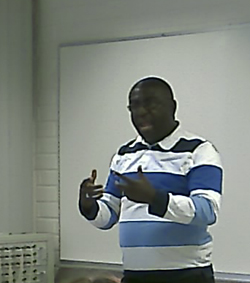 Nelson Godfried Agyemang
How to make sustainable Postgraduate in ICT education programmes in developing countries.
Action research methodology.
Kurt Lewin’s iterative process: diagnose, action planning, action taking, evaluating, specifying learning.
Important point: not to take research for consultancy.
Different sustainability stages: outcomes, processes, context, etc.
In the digitizing sustainability, not everything can be digitized.
Background: Edulink fosters ICT development in Africa. Its objective is to foster capacity building and regional integration in higher education in ACP States and Regions, and to promote higher education as a means of reducing poverty
.
In this framework, see what’s the role of the combination of Higher Education and Computer Science (e.g. degrees in computer science).
Perspectives: technological, economical, occupational, spatial, cultural.
The “C” in ICTs, as a difference with IT.
Background of ICT in Tanzania: post independence situation, development of ICT in Higher Education Institutions, public sector and SMEs reforms to include ICTs. ICTs have been really useful for SMEs to access remote information.
International standard curricula bodies for Computer Science: IFIP, UNESCO.
Curricula models and development: IEEE & ACM (1991 & 2001), UNESCO (1999).
Create a curriculum for a Bsc IT, following the six principles as input: contextualization, international recognition, project based, practical orientation, research based, interdisciplinary orientation.
Challenges: to move ICTs from entertainment to promoting change, by meeting social expectations in an efficient use.
How to do security evaluation using Architecture Tradeoff Analysis Method (ATAM)? How to promote time/cost-effective security evaluation of Software Architectures in developing countries?
Security is considered a cost overhead in developing countries and so is often left unattended.
A new framework based on ESAM Software to make it easier.
How is gaming and sharing knowledge relevant for ICT4D? Knowledge sharing for development.
Development according to Van Wagner: the growth of humans throughout the lifespan.
SECI model: socialization, externalization, combination, internalization. This is what happens in the sequence of gaming from a scenario towards a goal.
If we can shift content and education to the mobile zone arena — being mobile phones the most evenly distributed ICTs — then we can make some broad impact in knowledge shared based development. Mobile pervasive gaming is a vehicle to support learning.
Third Annual ICT4D Postgraduate Symposium (2008)
By Ismael Peña-López (@ictlogist), 08 September 2008
Main categories: Education & e-Learning, ICT4D
Other tags: e-health, Edephonce N. Nfuka, Evelyn Kigozi Kahiigi, ict4d_symposium_2008, IT Governance, Marilla Palmen, Niels Peter Nielsen
No Comments »
Notes from the IPID ICT4D PG symposium 2008, Mekrijärvi Research Station, Joensuu University, Finland. 8 and 9 September, 2008.
What is IT Governance? Business support, IT risks, performance, delivery time, service cost, service quality, etc. Basically, business people have to be aligned with IT people.
A holistic approach covering the following areas of improvement:
- Leadership
- Effective coordination mechanisms
- Reasonable IT investment
Research question: how could IT Governance in the public sector in a developing country be streamlined in order to improve public services delivery? A framework for effective governance:
- ITG Context
- ITG Mechanisms
- ITG Key Decisions
- ITG Maturity
- ITG Problems & Consequences
More info
Participatory action research approach to help health care workers to improve their work. “My Wellbeing” is an e-health tool (actually in conceptualization phase) for families and individuals to monitor their own health.
Challenges: how to know the user needs? how to know the best way to fit them?
Some approaches to conceptualize this “my wellbeing”
- Health services development
- Information needs assessment, information behaviour, information seeking behaviour, information practices
- Personal information management
Ugandan framework for ICT and Education
- ICt acquisition liberalization (1996)
- Rolling out a National Data Backbone
- Growth of the ICT Sector
- Integration of ICT into the curriculum of primary and secondary education
- Integration of ICT in teaching and research in Higher Education
- SchoolNet Uganda, Uganda Connect, Research Network of Uganda
BUT the reality is that there are ICT acceptance issues and limited utilization of ICTs for education: e-mail, LMS to upload notes, and powerpoint presentations to teach. Maybe due to limited access, maybe due to a lack of awareness in the educational framework.
Instead, there is a growing informal e-learning in Uganda: Internet, chats, e-content, mailing lists and chats… This informal e-learning should be exploited.
[this reminds me of Ivan Illich, Sugata Mitra and others about deschooling society and being confident about the ability of children to self-teach themselves when an appropriate framework is provided.]
Main issues:
- Need for active policies to spread ICTs in rural areas and the benefits of investing in agriculture.
- How does access to mobile technology influence the rural residents bargaining power in the market place?
- How do mobile technologies fulfil social functions in the marketing process? How are issues discussed including and beyond “pure” price negotiations?
Based on action research.
Third Annual ICT4D Postgraduate Symposium (2008)