By Ismael Peña-López (@ictlogist), 10 February 2009
Main categories: Cyberlaw, governance, rights, Digital Divide, e-Government, e-Administration, Politics, ICT4D, Knowledge Management, Nonprofits, Open Access, Participation, Engagement, Use, Activism
Other tags: cooperacion20, cooperacion20_2009, najat_rochdi
2 Comments »
Notes from the the II Encuentro Internacional TIC para la Cooperación al Desarrollo (Development Cooperation 2.0: II International Meeting on ICT for Development Cooperation) held in Gijón, Spain, on February 10-12th, 2009. More notes on this event: cooperacion2.0_2009. More notes on this series of events: cooperacion2.0.
Innovating in the Use of ICT for Human Development: the Key in the Transition to a New Phase in ICT4D
Najat Rochdi, Deputy Director in charge of Policy, Communication and Operation at the UNDP Liaison Office in Geneva
The goal: achieve the Millennium Development Goals. Can we do it the proper way?
What’s the connection between ICTs and poverty alleviation? What does it really mean ICT4D?
And it’s not about the poorest ones only: the crisis that began in 2008 — and it’s absolutely blasting in 2009 — is also about how ICTs can contribute to alleviate its effects. Access should be able to enable people to progress. But access is unevenly distributed.
The private sector has lead innovations in the ICT field. The development sector should also be reached by such innovation processes: new ideas and new applications of old ideas. We need to leverage knowledge
. We have to shape the changes, not be shaped by the changes
.
A new digital aid is coming
, based on the citizen, on the individual, empowered by the web 2.0 and the upcoming web 3.0.
Web 2.0, added to text messaging, is opening a new landscape of participation and democracy. The web 2.0 and mobile technologies do not only increase development by empowerment, but also create new markets that make it sustainable.
Sharing is the key to ICT4D success: share methodologies and instruments, best practices, research, data, etc.
But there’s urgency in pursuing these goals and putting hands to work in ICT4D related issues. And commitment is needed too. The resources, the human capital, the technology… everything is out there, but we need to bring it to the ones that need it, and we need to do it with a broad political support.
Take hold of the future or the future will take hold of you
.
Debate
Q: how do we know we’re really addressing the real needs? A: It’s a collective responsibility. We have to abandon the idea that development agencies and organizations know everything, and that there’s so much to learn from local communities, that we have to engage them in the making of the projects.
Caroline Figueres: Participation and communication is already happening on the field. The problem is that is not being known elsewhere. We have to make it sure everything is well known.
Q: What happens when there’s no infrastructure? A: Mobile technologies seem to be helping in the infrastructures issue. On the other hand, it’s important to catalyse the demand, so that the private sector sees there’s a niche, a need to be covered that can report benefits. A holistic, multi-stakeholder approach is what has to be solved beforehand.
Q: Why is there not an international political commitment to apply the same energies to poverty alleviation than to the financial crisis? A:
Manuel Acevedo: Next step? A: We need scalable initiatives. To do so, from the beginning a quantitative approach has to be made so that sustainability can be (sort of) calculated and know that there is a potentially high probability of success. We do not use to document projects, to see whether we can share outcomes and learnings, specially methodologies. We have to end up with experimentation, and go to the field scientifically prepared. We have to innovate (i.e. apply tested things), do not experiment.
Anriette Esterhuysen: (re: Caroline Figueres) it’s not already happening. There is no continuity, hence there is no scalability. On the other hand, there’s lack of capacity and ability to communicate knowledge. And, in this time of crisis, what will happen to ICT4D projects and institutions? A: ICT4D is not marketing issue you can cut down to reduce costs. Is a matter of international survival, so commitment will (hopefully) stand. The private sector is playing a most important role in developing countries and is there to stay, it’s boosting and changing a mindset change.
Development Cooperation 2.0 (2009)
By Ismael Peña-López (@ictlogist), 15 October 2008
Main categories: Cyberlaw, governance, rights, e-Government, e-Administration, Politics, Information Society, Meetings, Participation, Engagement, Use, Activism
Other tags: Barack Obama, Carol Darr, Hillary Clinton, idp, influentials, sociedadred, sociedadred2008
2 Comments »
Notes from the course Network Society: Social Changes, Organizations and Citizens, Barcelona, 15-17 October, 2008.
Citizenry in the Network Society
Carol Darr, Harvard Kennedy School
One American in then tells the other nine how to vote, where to eat, and what to buy. They are The Influentials
(Ed Keller & Jon Berry).
Obama had little influence, short experience, etc. to have rallied for being the democrat candidate to the presidency of the US: to raise votes and, most important, to raise money. What did happen so that he could be a candidate to the primary elections and, actually, to end being the candidate to the presidential elections? Everybody can buy products, but not everybody does: how do you make people buy your product? There’re some people that influence others to do things.
The Influentials find new ideas, find new people, and gather information because they are all the time picking and pulling information from anywhere. The Influentials know what’s happening in their communities and build social networks, because they know e.g. twice as many people as any other person, and hence they are at the forefront of whatever is happening… or going to happen.
The Influentials are important, especially for politicians and governments:
- Other people look for them and value their opinions
- They engage and are active within their communities
- They are at the cutting edge of events, 2 to 5 years beyond the rest of the world
- They are deeply interested in politics
Being influential is about being engaged in community activities, disseminating information about these activities, letting your ideas being known in media or at events, directly letting your ideas being heard by decision-takers by taking part in their events or agendas or teams, etc.
Influentials, Poli-Influentials and Politicians
Influentials and Poli-Influentials do more things that define the profile of an Influential than politicians or other people do, especially those activities that are more active. But, indeed, also passive political activities have a higher level of engagement amongst Influentials and Poli-Influentials.
When talking about online proactive political activities, Poli-Influentials detach themselves from Influentials and Politicians, that (while less active the latter), approach their profiles.
Poli-Influentials have usually (and significatively) reached a higher education level, being 60% of them post-graduates (PhD, masters, etc.). Notwithstanding, education does not affect the kind of activities taken by anyone, just the degree. In other words: the more education, the more influential activities people engage in, but in just the same proportion (online vs. offline, imparting a conference vs. writing an article, etc.) that other people not as much engaged. As expected, passive activities get the lion’s share vs. proactive activities.
It’s astonishing [appalling?] to see how little involved Politicians are. And, against all myths, how highly involved are intensive Internet users.
Q&A
Q: If Barack Obama won the presidential election, would he be keeping the online channel “open”? Or was it just for campaigning? A: He does not have a choice. The conversation is set, so it is plain impossible to close it. People are now empowered, and they are not letting this be lost. On the other hand, the online channel benefits Barack Obama: because of the young profile of Internet users; and because the Internet requires proaction (is not passive) so it benefits charismatic leaders because their magnetism drives people inside the Internet and proactively look for information and engage in whatever online action.
Ismael Peña-López: This is the description of a profile… but what about the performance of these profiles? Politicians (by construction) get what they planned (they’re ruling anyway), but what about Influentials and Poli-Influentials? Why not everybody that does the things that influentials do, are that influent? What happens when influentials become rulers? Is it good? Is it bad? A: We might not know what Influentials’ impact is as individuals, taken one by one. But we do know that the activities that define the Influentials and Poli-Influentials profiles do have an impact on politics. Hence, we can infer, at the aggregate level, that the more influential activities you’re engaged in, the more influential (again, at the aggregate level) you’re likely to be. And, indeed, people behind influential activities are often used as an asset by partisans and politicians, to get ideas from them, to recruit them, etc. Concerning politicians (and other people) not engaged, this is a luxury that is not sustainable in he long run: the Internet has showed the power that it can feed to a newby (i.e. Obama) that knows how to be engaged and use empowering tools to raise communities and debate around him.
Q: what’s the liaison between online and offline engagement? A: There’s a closest link. People were already engaged before the Internet. The Net just made it easier. Of course, as an easier way to be engaged, it is becoming an excellent entry gate for people flirting with being influential, but all in all, sooner or later, they’ll create their offline or local communities, and engage in many other activities different than online.
Q: are offliners cease to be influentials? A: Not yet. There’s always people that knows everybody, the big media, the professional apparatus, etc. But it is likely to happen that the raise of video, that does not require written fluency, will shift the landscape towards a more balanced distribution of influence.
Q: Was it the lack of women in the Internet the reason why Hillary Clinton was not elected? A: Not likely. Barack Obama won because of other reasons: change, connection with the young, a personal philosophy similar to that of the Internet (freedom, conversation, proaction). Hillary Clinton represented just the opposite philosophy.
Marc López: Are we going towards a fragmented way of policy making? Towards a world of nano-lobbies and politicians serving nano-lobbies’ interests? A: Guess it’ll be just that way. Every single person of the world with a cellphone + camera has a world wide reach TV emitter.
More info
Institute for Politics, Democracy & the Internet (2004) Political Influentials Online in the 2004 Presidential Campaign ( , 2.92MB)
Network Society: Social Changes, Organizations and Citizens (2008)
By Ismael Peña-López (@ictlogist), 02 October 2008
Main categories: Cyberlaw, governance, rights, Meetings
Other tags: idp, intellectual property, IPR, Miquel Peguera
1 Comment »
Research seminar by professor Miquel Peguera at UOC headquarters about cyberlaw, focussing on ISP liability related to Intellectual Property Rights (mainly under the Spanish law).
Webs with links to P2P files
The case of Sharemula.com: main entertainment firms claim IP violation, because the site links (eD2k links) to files protected by copyright, shared in P2P networks. As Sharemula does not host itself the files, the site is not liable for copyright infringement.
Google Cache
The case of Megakini.com: quoting text in the search results is fair use; forbidding caching would be extending authors’ rights beyond its purpose.
(Surface) links
The case of Iura Rech: linking a web site is not a crime, but the link should be removed under petition.
Adwords
The conflict between organic searches in Google and Google Adwords: a trademark can be bought as search term (a Google adword) by an institution that does not own that trademark. For instance: adidas.
Two claims: to Google for selling that trademark; to third parties, for inducing mistakes or appropriation of other’s trademarks.
Law is not clear and it really depends on the country, the claiming and defendand parties, etc.
Video Hosting
The case of Viacom, the case of Tele5 vs. YouTube: in principle, ISPs are not liable for hosting third parties’ content. But e.g. YouTube goes beyond just hosting third parties’ content. So, what’s the solution?
The case of Io vs. Veoh: Veoh has not been found liable.
Auctions
Is eBay liable for publicising sales of pirate products?
Blogs: comments and data protection
Personal data appearing in blog comments is not liable for infringing both (Spanish) LOPD and LSSI, as it is assumed that the blog is like an ISP, whose liability beings when it is noticed about the illegal/infringing content.
More info
Miquel Peguera (forthcoming) When the Cached Link is the Weakest Link: Search Engine Caches under the Digital Millennium Copyright Act. In Journal of the Copyright Society of the USA
By Ismael Peña-López (@ictlogist), 01 August 2008
Main categories: Cyberlaw, governance, rights, Digital Literacy, e-Government, e-Administration, Politics, e-Readiness, ICT4D
Other tags: in3, phd, uoc
No Comments »
The PhD on the Information and Knowledge Society Programme recently opened the call for candidates — including 10 full time fellowships —, offering 33 student places in the following fields:
As said, UOC‘s research institute, the Internet Interdisciplinary Institute, offers 10 grants for full-time PhDs that are carried out physically in its headquarters in Castelldefels’s Mediterranean Technology Park (20 minutes from Barcelona). It carries a stipend and access to travel funds.
Please visit the PhD programme‘s website, for detailed information about the places on offer and the fellowships.
By Ismael Peña-López (@ictlogist), 15 July 2008
Main categories: Cyberlaw, governance, rights, Education & e-Learning, FLOSS, Meetings, Open Access
Other tags: fkft, free software, fsf, richard stallman, rms, stephen downes
8 Comments »
Conference by Richard M. Stallman at the First International Conference Free Knowledge, Free Technology – Education for a free information society in Barcelona (Spain), 15 July 2008, on the production and sharing of free educational and training materials about Free Software.
Free Software is about giving freedom to the user and respecting the work done by the community of programmers.
The analogy with cooking recipes is clearly the best way to help people understand the four freedoms of Free Software.
Electronic book readers are evil
The key to promote Free Software is not software in itself, the possibility to be able to “cook”, but: as long as software is needed to do more and more things because of the pervasiveness of the Digital Economy, then we’re talking not about the freedom to run some software, but the freedom to perform a lot of activities.
For instance, e-Books, DRM, etc. attempt against the possibility to lend books, or give them to your sons and grandsons, because electronic book readers are not made on free software, hence they subjugate the user to the retailers’ will. Buying such devices is like stating you don’t want to share your books
so you should advice your friends that, if they buy these devices, you won’t be friends anymore, because they don’t want to share books in a community of readers
.
So, the problem is not software in itself, but changing (to worse) the model of society we’re living in to another one more closed, selfish, commoditized, etc.
Free content for a free life
Practical, useful, functional works should be free
- Software should be free
- Recipes should be free
- Reference works, like encyclopedias, should be free
- Educational works
- Font types
You have to control the tools you use to live, to shape your life. If you don’t, you’re not free.
There’s some content that can perfectly not be free. Opinion works are one of those, as it is important not to be misrepresented. But, sharing should be made possible for each and every kind of work. And this includes music sharing.
Copyright should only cover commercial use, modification of originals.
When a work embodies practical knowledge you’re going to use for your life, it should be free and it should be free to be modified. It’s not the case of art. Art should be shareable, but not modifiable.
Teaching free software vs. teaching gratis software
We should teach values, not some specific software: (a) because it’s values schools are expected to be teaching, (b) to avoid dependency from specific companies.
Thus, schools should only bring free software to classes. And free textbooks.
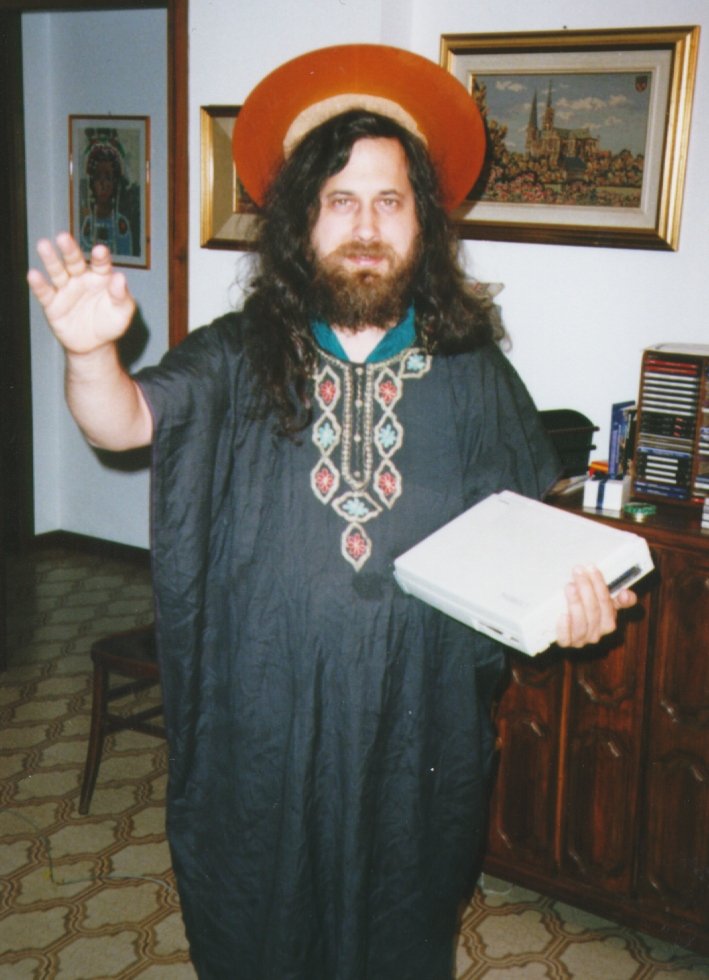
[now RMS transforms himself into Saint IGNUcius and things become really weird: he disguises himself, he auctions a book from the stage for 120€…]
Q&A
Q: What’s exactly the definition of “practical”? RMS: Well, it’s not easy to define, and we should be working on it, but it’s the concept that matters.
RMS: You shouldn’t use anyone else’s (web)server to compute with your data, because you’re losing control of your data and what is done with it.
Q: about free hardware. RMS: let’s not mix physical things with their designs. So, objects cannot be free because they cannot be copied, literally copied. It’s their designs that can be copied, but this is again a matter of intellectual property rights, not ownership of physical things.
RMS: it’s good that medicines are produced under a controlled environment (i.e. patents and proprietary labs) because people can die if there are errors in them
. My comment: wasn’t free software supposed to be better than proprietary one because given enough eyeballs, all bugs are shallow
? (see answer below).
RMS: What we know about proprietary software is that it is a good way to concentrate wealth
. So, it’s not that jobs will be lost, but some rich people will end being it: the question is whether we want to swap some billionaires for more jobs.
Stephen Downes: should we make it compulsory to share our software at classrooms? does this apply or extrapolate to educational resources? RMS: sharing should be a fundamental value to be taught at schools, so yes, sharing software should be compulsory, and same applies to content.
Stephen Downes: the problem is that the boundaries of what a classroom is are blurring, so where’s the redline? should, then, sharing software (and content) be made compulsory to everyone and everywhere in society and the world? If not, if we’re to keep some freedom not to share, where’s the line that separates classroom from the rest? Can we sell free works? Can schools sell free works when there’s an unbalance of power between the school and the student? RMS: no, the schools have no excuse to sell copies, because the works are free.
RMS: (back on the issue about some processes being controlled at closed labs) have nothing to do, it’s orthogonal
, with the free software issue. Security is not about being free or not — Stallman stresses here the difference between Free Software and Open Source Software, between the ethics and philosophy of the former and the technicalities of the latter. Security and Linus’s Law are related to Open Source Software, not about it being free or not.
Free Knowledge, Free Technology. Education for a free information society (2008)
By Ismael Peña-López (@ictlogist), 25 June 2008
Main categories: Cyberlaw, governance, rights, Meetings
Other tags: Add new tag, columbia, copyright, intellectual property rights, ip, jane ginsburg, ugc, ugc services
2 Comments »
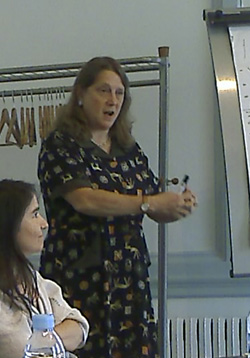
Seminar by professor Jane C. Ginsburg, at UOC headquarters, 25 June 2008, about copyright liability of user generated content practices.
Copyright infringement actors
Who’s implicated?
- Users, for uploading copyrighted material, make copies, remix material, etc. If there is no fair use, downloading (and storing in one’s own computer) is a copyright infringement too. Users are directly engaged in copyright infringement.
- Websites, and their operators, for making available copyrighted material. Website operators are directly engaged in copyright infringement too. What happens with host service providers and access providers? Hosts too are directly implicated, as illegal copies are stored in their computers.
- Aggregators of links, though they do not actually have the content on their facilities, they are directly implicated too. But they are in practice making the content available (in a very broad sense) by linking to the one that put it online. A lighter interpretation of the Law would consider these agents as implied in an indirect (not direct) way to copyright liability.
- P2P software distributors and sites, as in the previous case, are indirectly implicated by enabling access to copyrighted content.
 Jane C. Ginsburg
To be liable for copyright infringement, the sole existence of the digital file is considered a copy, and hence an illegal copy. On the other hand, technically the transmission of the file should be completed to imply copyright infringement, so not only making the file available but having accessed/copied it should be demonstrated (which is very difficult to) to imply such an infringement. Due to technical difficulties, normally the defendant is asked to demonstrate that actual access did not too place.
Host service providers and access providers, though directly (or indirectly, depending on interpretation) related with copyright infringement, usually have special regulation regimes to protect their economic activities.
Kinds of copyright infringement
Contributory infringement: you furnish the means, with knowledge, to enable copyright infringement. If these means are capable of substantial non infringement use, then the distribution (e.g. mp3 reproducers) is lawful, even if means can be used unlawfully. The problem is what substantial really stands for. So the usual defence is about providing evidence that no knowledge of criminal activities were taking place (e.g. Kazaa not having a central directory of files).
Inducement: what’s the intention behind a specific activity? There’s inducement if there is an explicit promotion for a certain (illegal) use. There’s inducement if there is no filtering (when possible), no intention to prevent illegal uses. And there’s inducement too if there is a business plan closely related to the illegal use. Failure to filter is usually related to a business plan based on this lack of filtering out illegal content.
Vicarious liability: direct financial benefit from the infringement, with right to control it (e.g. hire a band that performs copyrighted music; advertising in sites that illegally distribute copyrighted content).
User Generated Content and copyright liability
A paradox (in legal terms): even if the amount of illegal content on YouTube is a minor part of the whole, the share of visited illegal content is the majority of it. And even if illegal content can be taken down, it comes up within few minutes. [a detailed analysis of YouTube’s liability ensues, too dense to track here].
More info