By Ismael Peña-López (@ictlogist), 10 January 2013
Main categories: Education & e-Learning, Hardware, News, Participation, Engagement, Use, Activism, Writings
Other tags: business_school, cloud_computing, merce_guillen, oer, soc, social_networking_sites, uoc
1 Comment »
During the last two academic courses I have made some collaborations with the Open University of Catalonia’s Business School and the joint project in e-training for unemployed people between this university and the Catalan Employment Service.
I was asked — in both cases — to author some learning materials on Cloud Computing and Social Networking Sites. The target of the courses were micro-entrepreneurs in the former case and unemployed people in the later. Thus, those would be very short courses (usually 4 or 5 weeks long), that required very short time spans (people are busy running their businesses or looking for a job) and with special emphasis that they had to be really practical, avoiding theoretical digressions. In other words: useful courses for partial-time (even casual) learners.
I here present the materials that Mercè Guillén and I penned together. There are a total of 4 learning materials that we are free to share as open educational resources under a CC BY-NC-ND license. The courses are as follows:
- Social networking sites for unemployed people, in Catalan.
- Cloud computing for unemployed people, in Catalan.
- Cloud computing for micro-entrepreneurs, in Catalan.
- Cloud computing for micro-entrepreneurs, in Spanish.
For those interested, you will see that while the Cloud Computing courses share some content, their approach is quite different, the second one (for micro-entrepreneurs) following the usual design of a (fictional) case-study.
Downloads:
Mercè Guillén Solà, Ismael Peña-López (2011).
“
Xarxes socials i professionals a l’empresa“. Materials d’aprenentatge per al Programa d’e-Formació del Servei d’Ocupació de Catalunya i la Universitat Oberta de Catalunya. Barcelona: Universitat Oberta de Catalunya.
Ismael Peña-López, Mercè Guillén Solà (2012).
“
Informàtica en núvol“. Materials d’aprenentatge per al Programa de Gestió i Direcció de Microempreses de la Business School de la Universitat Oberta de Catalunya. Barcelona: Universitat Oberta de Catalunya.
Ismael Peña-López, Mercè Guillén Solà (2012).
“
Computación en la nube“. Materiales de aprendizaje para el Programa de Gestión y Dirección de Microempresas de la Business School de la Universitat Oberta de Catalunya. Barcelona: Universitat Oberta de Catalunya.
By Ismael Peña-López (@ictlogist), 12 September 2009
Main categories: e-Government, e-Administration, Politics, Education & e-Learning, ICT4D, Meetings
Other tags: annika_andersson, ict4d_symposium_2009, iginio_gagliardone, ipid09, mathias_hatakka, michelle_afifa_harris, oer
No Comments »
Notes from the Fourth IPID ICT4D Postgraduate Symposium 2009, held in the Royal Holloway University of London, Egham, United Kingdom, on September 11-12th, 2009. More notes on this event: ict4d_symposium_2009.
The Social Construction of ICT as a Strategy for Development in Jamaica
Michelle “afifa” Harris
Development challenges in Jamaica: high crime rate, unemployment, inadequate resources, etc.
According to the e-Readiness Report 2006, Jamaica has inadequate ICT infrastructure, limited contribution of ICT to GDP, unreliable electricity, limited Internet connectivity, low computer ownership, low innovation in the area of ICTs.
Why ICT policies, though? Are particula perspective shaping ICT policy? Are particular interpretations of realities shaping policy? What are these interpretations of the reality?
Research questions
- How have decision makers interpreted ICT as a developemnt strategy for Jamaica?
- How do these interpretations construct the need for using ICT as a development strategy? What are the discourses associated with this construction?
The national ICT strategies are being analysed to see what the backing discourses are, and which the underlying assumptions and conceptions around ICTs that policy-makers used in their discourses. The research, in the end, wants to provide a critical analysis on the process of policy creation and therefore the ideas and perceptions behind the adoption of National Strategies, deepening the discussion on the role of discourse in agenda setting.
Initial findings on the meanings and interpretations of ICT4D-Thematic areas:
- Us the power of communication to make us better
- About empowering people
- About enabling people
- Using the IT sector to generate development
But this was placed in the context of what “modern” development required particularly with definitions which seem to underscore the importance of creating a “knowledge based economy”.
Initial findings on the reasons for ICT as a tool for development
- Ability to drive development
- Necessary Government action
- Responding to Global developments
Initial findings on the themes and areas of Discourse
- Education and e-Learning Jamaica projects
- Agriculture-ABIS system for Farmers
- Community Development-Community Access Points
Open Educational Resources for Development. Let’s be realistic about its potential!
Annika Andersson & Mathias Hatakka
Do open educational resources (OER) have any impact in education and/or developing countries? There’s a good amount of literature that state one or the other one or both, so this research pursues testing it in a real environment.
The problem is how to measure the impact of OER on development, as development itself is a complex concept. So, the research will look at its use, how are they looked at and what’s the impact on development.
ICTs regarding to use: OER are seen as a commodity, supporting development activities, as a driver of economy (increases productivity, efficiency), and directed at specific activities.
ICTs views: OER as a tool (OER as seen as a way to build your own resources), computational, ensemble, proxy (OER as an enabler for empowerment).
ICTs impact: OER as a replacement, the increase of a phenomenon, OER as a transformation.
Issues/hypotheses:
- Tertiary effects are hard to measure?
- OERs do not contribute to development?
- OERs are not designed in a way that they can contribute to development?
- OERs are not used enough to have an effect?
Re-shaping ICTs for nation building: the Ethiopian case
Iginio Gagliardone
In Ethiopia there were some projects that costed a total amount of 300,000,000$, coming from the government treasury (not the donor agencies), projects that you wouldn’t find in the richest countries of the World. How did they came to think of, design and implement such projects? What was the mindset behind them? How was the political discourse embedded in technology?
In the late nineties, the minority from Tigray came to power and are since building a federalist while centralized state. There’s thus a need to decentralize to suport their ideology but also to exert a central control to make sure they can stay in power. Here is where ICTs come to the rescue.
Videoconferencing technologies for political administration, or broacasted lectures for education, are indeed being used to disseminate discourses about the nation at the grassroots level and among those in power. On the other hand, they reinforce the presence of the government around the nation (just for the record, all the web servers and their related services are hosted at the president’s seat).
This is a clear case where technology is not created to empower but to control.
Downloads
Fourth Annual ICT4D Postgraduate Symposium (2009)
By Ismael Peña-López (@ictlogist), 09 August 2008
Main categories: ICT4D, Setup
Other tags: learning materials, oer
1 Comment »
Three years ago I set up ICT4D Courses, a repository where I would be uploading learning materials related to training courses in the field of ICT4D.
After that time, the repository has not grown at all — it was somehow part of my MPhil’s dissertation.
On the other hand, I had recently created ICTlogy Learning Materials Series, a place where to upload the learning materials that I had created.
Now, it does not make sense to be having two different places for the same thing: open educational resources, so I merged them into one. The URLs have not changed, just the respository, that now holds everything concerning open educational resources:
You’ll see it missing from the top menu, but you can always access it at the Bibliography, and then go to Types of Works and Learning Materials.
By Ismael Peña-López (@ictlogist), 09 April 2008
Main categories: Digital Literacy, e-Readiness, Open Access
Other tags: education 2.0, networked readiness index, nri, oer, wef, world economic forum
No Comments »
The World Economic Forum’s Global Information Technology Report 2007-2008 is out. In my opinion, it does not bring any surprises, but reinforces some trends that we’ve been seeing lately:
- The increasing strength and importance of wireless technologies to get connected to the Network
- A gradual shift of the research focus from quantitative/economic impact analysis towards more qualitative/social impact analysis
- Hence, the realization that ICTs are much more than (information) productivity tools, and they have a role in socialization (through communication), mediated by digital literacy
Part of the Global Information Technology Report gets its data from the World Economic Forum’s Executive Opinion Survey, which, conducted annually, captures the perceptions of the leading business and investment decision-makers worldwide (many of whom represent the Forum’s member companies)
. As a qualitative survey, and based on perceptions
, all conclusions arising from it might be taken with tons of caution. Nevertheless, there are some findings that, even if taken with caution, are worth deserving a thoughtspan:
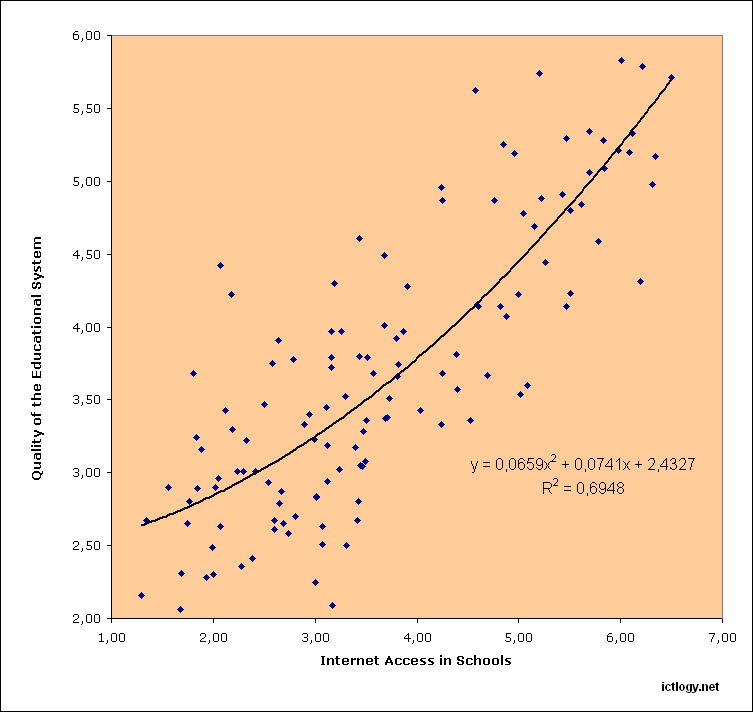
As the chart shows, there is a clear relationship between quality of an educational system (at the aggregate country level) and the existence of not computers but Internet access in schools. As said, while Internet access in schools is measured quantitatively after surveys sent to sample schools in every country, the Quality of the Educational System is a variable measured through a qualitative, subjective indicator after asking the 8,000 interviewees of the Executive Opinion Survey. In the survey, the respondents range the educational system from 0 to 7 whether the Educational system
[serves the] needs of competitive economy
.
Depending on how you agree with the definition of “quality” for a national educational system, and how you’d like the reality to fit your beliefs, different interpretations arise:
- The more straightforward: Internet access increases the quality of the educational system. The more Internet access, the better education.
- Inversely, we can say that high quality educational systems are more eager to introduce the Internet in schools than lower quality ones. The more quality of the system, the more (awareness in) the use of Internet.
- There’s a relationship between educational quality (as understood by the Executive Opinion Survey) and Internet access in schools, but we do not know which is the cause and which the consequence: they just happen to go hand in hand.
Even if some of the previous statements are sweet music for cyberoptimists (like me), I wouldn’t strongly stand for any of it: there are too many loose ends to be axiomatic.
But one thing is absolutely clear: even if we cannot establish (yet) any causality between quality and educational Internet access, the perception is that some degree of relationship does exist. And if this perception is widely shared at both the decision-taker and policy-maker levels, some consequences in the short run would be likely to be expected:
- Firms would be more likely to hire candidates with strong digital competences, as it looks like Internet and quality go together, and quality means a more competitive economy (i.e. firm).
- Stress would then be put in teaching digital skills in the design of educational strategies, along with the introduction of the Internet in the school
- If the Internet — this huge information silo — enters the classroom, the role of the educator should change, and shift from an information holder to a knowledge acquisition enabler or facilitator
- Open educational resources should be coming in and out of the classroom both as input and output
- This abundance of (educational) material would require more and better reputation systems and information assessment systems, all of them based in more and better digital skills
- And back to #1
In the most conservative scenario, I see this as the perception of inflation: regardless whether there is not the slightest chance for inflation to happen, if citizens believe so, there’ll be inflation. The sensation is now that digital skills matter and that we are going to evaluate education under this light. Schools must not just let themselves go along with the current (i.e. the cyberhype), but neither swimming against it.
By Ismael Peña-López (@ictlogist), 05 February 2008
Main categories: Open Access
Other tags: creative commons, free software, oer, open_access, open_content, open_educational_resources, open_paradigm, open_science, open_source_software, websicence
10 Comments »
I am imparting a short, informal seminar about the Open Paradigm (Open Access, Open Science, Open Educational Resources, Open Source Software, etc.). To support my speech — and prepare the audience — I draw a simple diagram and collected some suggested readings. Here they come. As always, all comments are welcome.
Map/Diagram
Flash plugin or Javascript are turned off.
Activate both and reload to view the mindmap
If you’re using a feed reader, sorry but have to visit the site ;)
Click and drag to move the map. Click on tags to expand. Click here to open in full new window
Readings