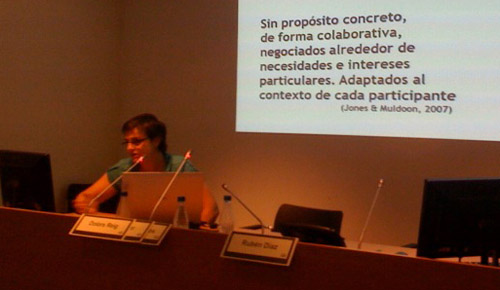
Mobile Learning in rural environments and development countries Dolors Reig, Consultant & editor-in-chief at the ICT – educational weblog El Caparazón, Spain
The Internet is not about empowerment of new leaders, it is about the empowerment of everyone (Levinson).
The context of m-learning is changing: the penetration of the feature phone and the penetration of the smartphone is converging and the latter could catch up with the former by 2011 Q3 according to Nielsen. Today, 14% of total web traffic comes from mobile phones and for 70% of 16-25 youth mobiles are the most important media.
Of course, the context in which education takes place is also changing and the system is in a dire crisis. There is an increasing trend towards open social learning. Clay Shirky states that there is a cognitive surplus, a social surplus and a creative surplus in collaborating and creating collectively.
The social web is definitely boosting the upper stages of Maslow’s pyramid. And the social component is now more important than ever. This rising social component is having a positive impact on education: it is now more easy than ever to get information and, indeed, to get answers to one’s queries. The web is a research, knowledge platform. John Seely Brown states that mobiles are curiosity amplifiers.
The digital divide is increasingly a participation divide.
Discussion
Eva de Lera: How much are institutions an obstacle to m-learning by trying to replicate the “ancient” methodologies to mobile phones? How much is it about technologies and how much about pedagogies? A: Yes, we should adapt the pedagogies and methodologies to the new devices, but not only the devices, but the new paradigms that the new platforms imply.
Share:
UOC UNESCO Chair in Elearning VII International Seminar: Mobile Technologies for Learning and Development (2010)
There is a difference between networks where content is generated and is what binds the network together, and networks where the social component is what provides sense to that network. Wikipedia is an example of the first one; Linkedin is arguably an example of the second one. Probably the former ones are more engaging.
To create valuable content, a goal is needed, and thus comes a need for focusing. This goal, notwithstanding, may not be included in the original design, but come with the use that the users do of the social networking site.
Chris Csikszentmihályi points to the decreasing (and almost non-existent) transaction and coordination costs of bringing people togheter and build things collaborativelly that Yochai Blenkler explains in The Wealth of Networks: ICTs have made collaboration so cheap that centralization may not make a lot of sense or, in other words, decentralization of production is now feasible in many more ways than it was before.
Indeed, most people need specific cases or even direct commands so to start up using an online service. I f you’re told you can do “anything” on a web site, that’s what you’ll do: nothing. A good example to kick-start a service was Twitter: “what are you doing?”. With time, it evolved to much more than what one was doing. But for starters, the idea worked.
Discussion
Llorenç Valverde: so, translated to the education arena, problem based communities, addressed to specific topics and with clear rules is what would work. That would contribute in building a community. But, why don’t online students usually gather around virtual communities and/or specific “social learning networking sites”?
Chris C.: And how do you make people engage if 2% will be creators and 98% will be lurkers?
Eduardo Manchón: there actually are two really separate communities (creators and lurkers) and the one that really matters is creators. You have to develop your site for the creators, for the content generators, for the active ones.
Lev Gonick: We have situational communities and we have intentional communities. Sustainable communities are more on the intentional side of communities, strongly motivated and are normally well moderated/led. And we should try and find, in the educational field, what is the difference we are making, what is the advantage we are providing our students.
Eduardo Manchón: (some) noise and (some) trouble helps the community to raise, and to mature. Online communities are small societies and so they need some controversies to grow in all senses. Of course a minimum amount of moderation is needed, especially to avoid the destruction of the community as a whole, but tension is generally good, is a sign of health.
Eduardo Manchón: we may know what does not work in a virtual community, we most probably do not know what does work, but we can only find out by creating the online community and bring it to live. So, the best advice when designing and building an online community is to build it and see whether people “comes”.
NOTE: As usual, this kind of events are much richer than what these humble notes may suggest :)
The professionals from the Catalan Justice Department are expert professionals that need no diffusion but working sessions where to share requirements of specific training and see whether any colleague might know or have a solution: the way to engage these professionals in training is, then, communities of practice.
On the other hand, the problem is that most of the times there is not a preset solution for many problems, as they are complex and need many approaches.
Technology enables a constant connection among peers, provided that everyone shares and collaborates and builds knowledge together.
A good thing about communities of practice (CoP) is that they can be shaped as needs require. The structure Compartim established has: an e-moderator that leads a working group, face-to-face meetings and online work, discussion, outputs, diffusion of these outputs (normally reports) and assessment of the whole process. The working group is smaller (+250 people) and its first approach to the problem is shared with the rest of the participants (+1300).
An external consultant provides seldom “knowledge pills” that feed a knowledge based, also fed by the library and the outputs of the CoP, which, at their turn, are provided by the employees.
Adaptation from face-to-face was tough: people used to sharing and participating in meetings, could dangerously evolve to the 1-9-90 standard: 1% heavy contributors, 9% intermittent contributors, 90% lurkers. With people overwhelmed with work, this could even get worse. The ratio they got was 16.17 active participation, rest lurkers.
One of the best outcomes was learning. From the 4 main components of the CoP (antenna, organization of know-how, production and learning), learning became the focus of the CoP and the main driver of satisfaction. And this learning has as origin tacit experts belonging to the CoP.
Digital competences at the Communities of Practice
At the Compartim CoP all kinds of digital literacies and competences were dealt with, specially Technological and Informational literacies, and much less (a “to do” for the nearest future) e-Awareness. But almost all kinds of tools, approaches and competences were dealt with, including digital identity/presence by means of LinkedIn.
Main characteristics of the learning process:
Viral design
Meetings and events with reputed people to trigger change and engagement
Short and really operative learning units, on a constant basis and always available
Presence and conversation, through blogs, contents on several platforms (podcast, vidcast, etc.), netvibes, etc.
Strucutre of the learning process
Specific courses for e-moderators
Specialized seminars on knowledge management
Good practices sessions
Conferences
The blog proved to be the best tool as it could be uses in many applications and levels of knowledge, including the training of several skills at a time.
Besides digital competences, of course collaborative work was highly treated and trained. And learning proved to be higher the higher was the engagement of the members to the Community of Practice.
What’s next? more processes on a peer-to-peer basis; reinforce autonomous learning and people oriented towards learning; more work with tools, specially when there are new tools every day; creativity and lateral thinking; creation of Personal Learning Environments (PLEs) and professional e-portfolios, both at the individual and the collective (CoP) levels.
Q&A
Ismael Peña-López: how much have been CoP mainstreamed or embedded in everyday’s life? Jesús Martínez: the CoPs that are useless, just fade away. The ones that are interesting, with the appropriate support and digital skills training completely succeed and are used on a daily basis. Dolors Reig: because people are absolutely engaged, which is one of the main goals: engagement. CoPs have to be useful for work but also for other aspects of life.
Open Social Learning in Spain. Clarifying Concepts Dolors Reig
Dolors Reig. Photo by Carlos Albaladejo
Traditional e-Learning: everything preset, all paths settled. The evolution has then been, from the web to the social web, and from the social web to the personal web (Nova Spivack).
New ideas that shape the social web:
Intercreativity
Collective intelligence
Smart mobs
Wisdom of the crowds
Architecture of participation
Sharism
Open Social Learning
Digital natives: It’s problable, though, that the so-called digital natives they actually are “hanging out” online (danah boyd). Thus, the digital knowledge might not be that high within digital natives as we should expect.
Connectivism: the Internet is so shaped to learning because it works as we do, we learn as networks, learning happens when connections are created, the ability to learn is more important than knowing, etc.
Social learning: if markets are conversations (Cluetrain Manifesto), education and learning are also conversations, the prosumers and active students being the main characters of this era and peer-to-peer being the best way to acquire information and knowledge. From the “I think therefore I am” to the “we participate, therefore we are” (Minds on Fire: Open Education, the Long Tail, and Learning 2.0).
Informal Learning: Jay Cross states that 70-90% of corporate learning is informal. We have to enable this informal learning so that it can happen.
e-Learning 2.0
Generative Learning
Communities of Learning
Constructivism
Edupunk
Creativity: We should be focusing in what motivates people (à la Maslow): that’s why social networking sites are so successful.
Autonomous learning: what really drives knowledge is the process, not the output.
Universal, free and democratic learning (Soumitra Dutta).
Minimally invasive education, taking the example of Sugata Mitra.
An active role that is required to remix. At its turn, remixing asks for multiliteracies.
Metaverses: Augmented reality, lifelogging, etc.
Changes of roles: the student is not passive, but a participant. The teacher is a facilitator, a curator. And the information becomes a perpetual beta.
Technology becomes too a very important part of the equation: open APIs or all technologies that enable sindication (XML/RSS, Atom, etc.) are true drivers of this change.
Main conclusions
A web simple to use
People, collectives, interests, tags, twines, groups
Real time web
“If we know the exact cost, the exact agenda of a project, it is probable that it is based on an obsolete technology” (Joseph Gavin, Jr.)
In all this landscape, the e-Portfolio is very relevant, as it perfectly fits with and represents the digital persona. And, complementing to this, e-competences are the necessary tools to get on with digital life.
Q&A
Begoña Gros: We have to make an effort to link the newest technologies and applications with learning or education, and not separating them as if they belonged to different spheres. A: Agreed. Indeed, as we increasingly happen to know more and more uses of the Internet, people shift from “bad” practices (online gambling, porn, etc.) towards “good” practices (learning, communicating with peers, etc.).
Jesús Martínez: Teachers need to learn so that they keep being up-to-date and can keep on teaching. We should accelerate the process of change, of adaptation, or re-learning. A: One of the direst problems is not only that people don’t know, but that people (e.g. teachers) do not know that they do not know.