By Ismael Peña-López (@ictlogist), 22 August 2023
Main categories: Development, Knowledge Management
Other tags: Activism, bani, design_thinking, ecosystems, Engagement, facilitation, foresight, framing, futures, naming, Participation, Engagement, Use, Activism, potfolio_based_approach, sensing, stakeholder_analysis, system_analysis theory_of_change, Use, vuca
No Comments »
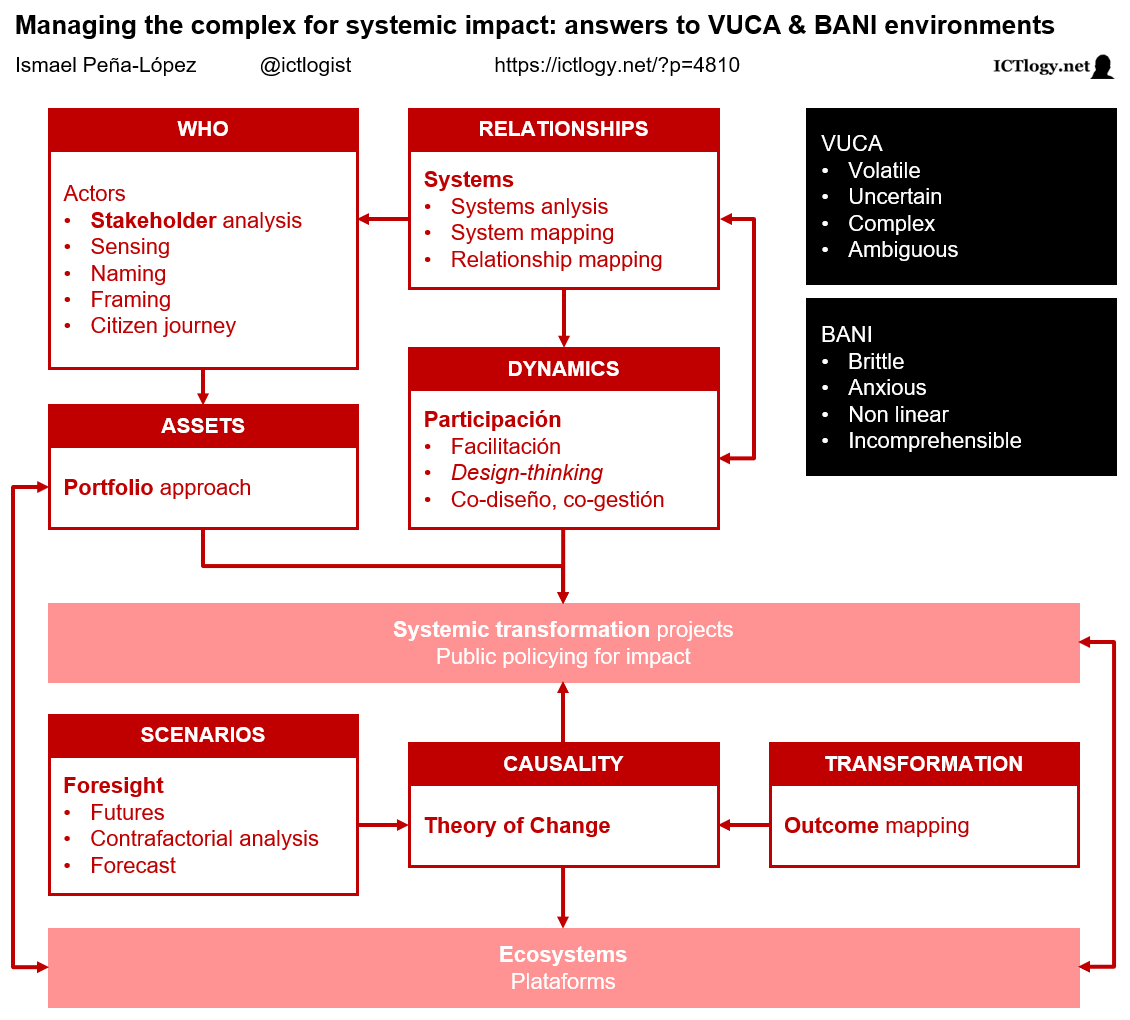
In recent decades, the acronyms VUCA and, more recently, BANI have become popular to describe the environments in which we live and work. But, beyond describing the situation or environment as VUCA or BANI, can we do anything about it? How can we change our way of managing projects or promoting impactful public policies? We have compiled below a set of emerging methodologies that allow us to move from theory to practice, from fear to action.
Table of contents
New environments: VUCA & BANI
VUCA
VUCA appears with the end of the Cold War, with globalization, with the digital revolution, with the financialization of the Economy. Adapting theories on leadership from Warren Bennis and Burt Nanus, it proposes that we increasingly operate in environments:
- Volatile: the dynamics of change are accelerated and the stages of the situations are short-lived;
- Uncertain: it is increasingly difficult to predict the future (and science must adapt to post-normality);
- Complex: where the causal relationships of a phenomenon are multiple and even impossible to define;
- Ambiguous: since it is difficult to make categorical statements, especially independent of each different situation or context.
BANI
Impacted by the COVID-19 pandemic, Jamais Cascio proposes in Facing the Age of Chaos to go beyond the definition of VUCA environments and suggests the BANI framework instead:
- Brittle: due to the extreme delicacy and contingency of situations, which can change quickly and drastically as a result of any cause;
- Anxious: in the sense that situations increasingly generate anxiety (due to the difficulty of dealing with them, due to the scope and depth of their impacts);
- Non-linear: due to the apparent disconnection, in direction and magnitude, between causes and consequences;
- Incomprehensible: since it is increasingly difficult to understand not only the causes but the very phenomena that we face.
Managing complexity for systemic impact
If the management of organizations, the fostering of public policies or the deployment of development (cooperation) projects follow one another in a practically deterministic way (if I do A, then B will happen) and a linearly way (few variables, always in a single direction), as environments grow in complexity, project management and impact public policies should also change.
With the management of complexity, new methodologies and approaches to management appear that incorporate three factors that were not always taken into account in traditional management, all of them related to the loss of control over the situation:
- Multifactoriality: realization and acknowledgement that there are many factors (particularly actors) that we do not control or even do not know, but that must be taken into account in the design as far as possible.
- Importance of design: since we cannot act arbitrarily or discretionally due to loss of control over factors, we try to control the playing field or, at the very least, to know it. Thus, the thoroughness on the design of the projects and the exhaustive knowledge of the environment are key.
- Influencing the system: although it may seem contradictory, since we are neither able to control nor often know the causal relationships, many projects will influence changing the system itself and will not limit themselves to operating within the system itself. The system becomes a dependent variable on which we can influence, not a variable that is given and to which we have to adjust.
Below we list some methodologies, approaches, concepts —with a more descriptive than normative goal— that incorporate new factors and perspectives to address the growing complexity in project management and public policies.
After each epigraph, a link “Some references on…” is added, which leads to a personal collection of documents that delve into the subject matter (on various occasions some documents are referenced in more than one epigraph when dealing with more than one topic).
Stakeholder analysis, naming, sensing, framing
The first major, necessary, incorporation of complexity is that of who, which actors intervene or are affected by an issue, a problem, a decision, a public policy. It does so through various names, each one with its particularities, the most common being the actor mapping and stakeholder analysis, but also interest groups and other denominations.
It is important to highlight that it is not only about making an inventory of actors, but also about how they read reality from their particular point of view. For instance, the question of housing has different readings and names depending on the actor: the problem of evictions, mortgages, rents, squatting, occupation mafias, immigration mafias, gentrification, tourist apartments, financial speculation, financialization of the economy, etc.
If we want to find solutions, we have to refine the diagnosis, and this involves incorporating all the different visions —without prejudices or moral judgments. How we “listen” to these actors —in Open Government we would speak of active listening— will be essential for the incorporation of all these visions.
Systems (systems analysis)
In the same way that it is done with actors, systems analysis tries to break down a complex problem into its basic components and processes, delimiting tasks, functions, relationships, direction of said relationships, etc.
Of course, systems analysis and stakeholder analysis are closely related, although while the latter is more focused on the subjects, the former is focused on their respective functions and interrelationships.
Systems analysis will provide better operational planning, improved ability to design and to implement better focused devices and assigning them the necessary resources (people, time, materials) to promote the components and functions that we want to leverage.
Foresight, futures
Foresight exercises are not new. “Foreseeing the future” —in the sense of considering what scenarios may occur in the future and with what probability— has been an exercise that humanity has carried out recurrently over the centuries.
However, the study of futures goes beyond mere prospective, for at least three reasons:
- For the abandonment of the hegemony of traditional statistics and the incorporation of post-normal science, which requires radical new approaches to the approach of what can happen and why.
- For to the incorporation of new actors and functions and the creation of new scenarios. In other words, and related to the previous points, it is not only a question of foreseeing what can happen, but of capturing what these future scenarios can be like, beyond whether they are possible and to what extent.
- For to the formation of new realities at the same time that we think about them, along the lines of what was previously commented on taking the system as an endogenous variable: futures exercises are often not only inventories of what can happen but also of what we would like to happen —and, as we will see later, what would have to be done to make them possible and probable.
Outcome mapping
Out of all the possible scenarios, outcome mapping helps us identify the effects we want to see happen. The concept of outcome is sometimes confusing and used interchangeably as effect or impact. Strictly speaking, in the activities we carry out, three stages of “impacts” can be distinguished:
- Output, result: the “thing” (good, service) that we have produced and that is under our control. E.g. a basic digital literacy course.
- Outcome, effect: the intermediate changes, in the short term, in which we have been able to influence directly. E.g. improve the ICT competence of some people.
- Impact, impact: structural changes (behaviors, visions of reality, etc.), in the long term in which we can influence indirectly but to which we ultimately aspire. E.g. improve the employability of a collective.
Outcome mapping focuses the analysis on those effects that we can influence and that are real changes in a situation. They force us to think (and design) for impact, for transformation, avoiding “solutions” whose results are an investment of resources without impact on the system.
Theory of Change
The Theory of Change is linked to outcome mapping and tries to find the causal relationships that lead to impact, what we can do to obtain a certain result or impact. The Theory of Change identifies the necessary resources to carry out activities that will have expected results controllable to a certain extent; and, based on these results, and the causal relationships inferred or found by experimentation, expect to be able to influence directly to achieve effects and, indirectly, to achieve results, impacts.
The Theory of Change, like any theory, must be validated and, for this, evaluated. In the Theory of Change, evaluation (measurement, verification, ratification or refutation) is fundamental and forms part of the various iterations of the implementation of the Theory of Change.
It is important to note that the Theory of Change, like the very definition of results, effects and impacts, is very circumstantial or contextual: there are intermediate effects that are impacts at another level of analysis and vice versa: impacts that, at another level, are mere results, that can lead to other higher impacts.
Portfolio-based approach
The portfolio-based approach is situated (conceptually) halfway between stakeholder analysis, systems analysis and the Theory of Change. If we admit that we do not have control over everything, and that we need to mobilize certain resources to achieve certain results, we need to know what assets we all have together and how we can align them to achieve a common goal.
Going back to the Open Government paradigm, it is about acknowledging, from this map of actors, how each one participates in the project, but not only with their vision, but also and above all, with their own contributions (materials, methodologies, etc.).
To some extent, the portfolio-based approach challenges the foundations of classical organizational theory: counting on resources that “are not yours.” But, with the appropriate strategy, they can be mobilized and aligned for the common objective. For this reason, this approach fits into the entire complexity management map, where actors, relationships, scenarios and causal relationships have an architecture that is so different from classical management by processes.
Participation, facilitation, design thinking
Faced with this great organizational complexity, how we implement it comes to the forefront, even coming before the planning itself, at least the operational one.
The participation of the actors in the processes of diagnosis, deliberation, negotiation, decision-making or evaluation becomes essential; and the facilitation and revitalization of these participation processes to achieve the objectives, so that participation is efficient and effective. Of course, the logic with which it is created (or co-created, and later co-managed) requires new design methodologies: design-thinking , agile methodologies and others are now incorporated into the toolbox to enhance it.
Ecosystems
Recently the concept of ecosystem has jumped from the realm of biology to that of technology, and from there to that of the social sciences. In a first meaning outside the field of life sciences, we speak of the ecosystem approach characterized by global vision, comprehensive action. It is a first meaning, but when we talk about governance ecosystems (of projects, of policies), the concept goes much further —going beyond what, in fact, could be assimilated to the vision of the system that we saw previously.
When we talk about acting with an ecosystem approach, we admit that its complexity often does not allow direct action. We saw it when talking about the multiplicity of actors, their relationships, their respective portfolios, how they co-design actions or align themselves with them, the multiplicity of scenarios and desirable results and impacts, the difficulty of establishing relationships causes over which we have no control (only influence, often indirectly). Given this scenario, the ecosystem vision is characterized, in addition to the global vision and comprehensive action, by:
- Act on the environment, on the context, to influence (indirectly) the results, effects and impacts. This is done by providing the generic infrastructure of the ecosystem.
- Promote the autonomy of the actors, providing transversal applications (methodologies, instruments, resources, codes, standards) that they can use freely.
- Align the different autonomous instances (projects, institutions) of the actors through the design of the infrastructure and transversal applications, promptly providing incentives that reward alignment or penalize (or leave rewardless) divergence.
The ecosystem vision, therefore, promotes the project or the institution as a platform on which others operate, where institutions and projects become open infrastructures for autonomous decision-making with collective impact.
In conclusion, the way of approaching projects, the management of organizations or the promotion of public policies is changing radically as a result of the verification of the profound (and constant and accelerated) transformation of the contexts and environments in which these take place. and they operate.
There is no single model, and often the methodological proposals are heterogeneous, from what are mere descriptions to highly complex organizational and operating architectures. However, all of them seek to overcome a way of designing and managing that shows many signs of fatigue, insufficiency, and inefficiency. For now —and, perhaps, for a long time— it will be necessary to arm ourselves with a new toolbox, profiles and skills to perform new tasks and tackle new challenges and try to provide solutions, always incomplete, always tentative, always temporary, but always also necessary to influence the environment, in the context, to, through these, progress.
By Ismael Peña-López (@ictlogist), 08 December 2020
Main categories: Development, Information Society, News, Writings
Other tags: antoni_gutierrez-rubi, carles_pont_sorribes, covid19
No Comments »
When working with the idea of the citizen participation ecosystem from the point of view of a national government, one of the basic questions is how the Administration should nurture and facilitate such ecosystem. There are, at least, two approaches that have been traditionally explored.
- On the one hand, the Administration can fund the creation or growth of a body of professionals that can contribute to deploy a number of citizen participation initiatives all over a given territory. These professionals can work at the higher level of the Administration or can be distributed or scattered on lower levels of the Administration (i.e. local administrations), but the result is to be able to cover most necessities with a good amount of trained and dedicated professionals.
- On the other hand, and sometimes compatible with the former approach, the Administration can fund the creation or growth of a constellation of facilities that would run initiatives specifically devoted to the promotion of citizen participation. They can have many names depending on their particular focus or especialization: citizen labs, living labs, social innovation labs, fabrication labs (fab labs), maker spaces, etc.
The problem with these approaches is, at least, double:
- They are not very economically sustainable, as they require and maintaining groups of people and networks of facilities with a single purpose and which can very difficult be replicated or scaled outside of their specific area of intervention. Of course this is a goal worth aiming at, but for starters it makes the investment very demanding.
- They are not very socially sustainable, as they divert the attention and focus of the citizen, which now has new places to go, which can be good, but also bad: people have a limited capability to gather at and to focus their attention on.
Another approach is to leverage the fact that there are already public facilities on place and that people are already using them and gathering around them. Thus, instead of creating a new network of people and facilities in addition to the existing ones, another approach could be creating a new network of people and facilities upon the existing ones, or in other words, overlapping new goals and uses with the already existing ones.
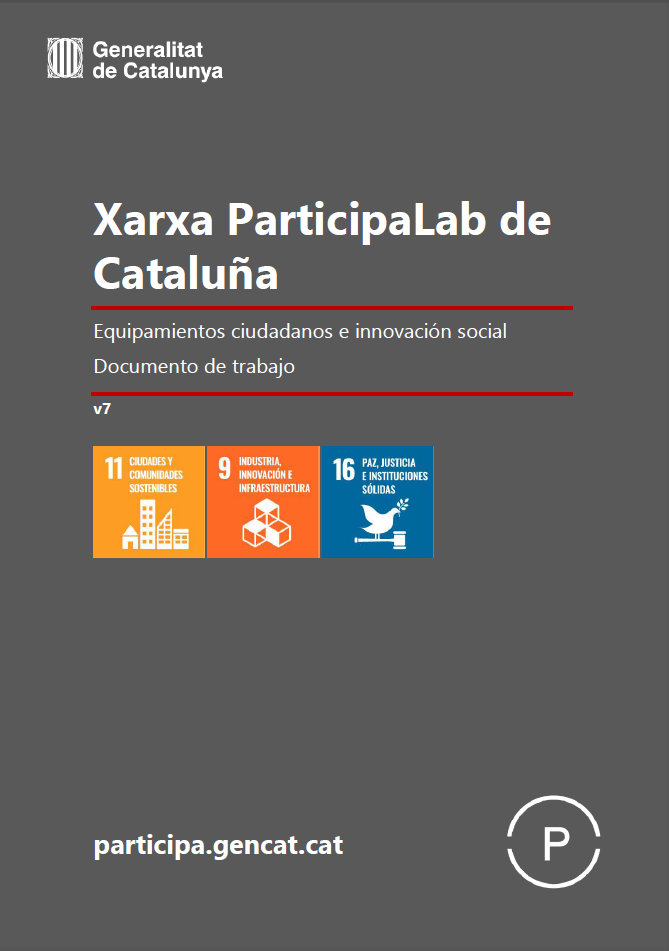
The Catalan ParticipaLab Network aims at just that. We borrowed the name from the successful ParticipaLab initiative of the Medialab-Prado in Madrid (Spain) but with the idea not to create a new big facility, not even a network of small facilities, but to weave a network of citizen labs by providing a portfolio of new content and services to the already existing networks. The logic behind it is to follow Artur Serra’s ideas on citizen labs, who proposes thinking of citizen labs as we do in public health systems: there is a large network of primary health care you go to when you feel sick, a second network of regional hospitals you are sent to if things get complicated, and national network of top-level hospitals you are sent to when the situation becomes really bad. Same would apply to citizen participation and social innovation.
With that logic in mind, big top-level citizen labs would be the top-level hospitals of democratic innovation; regional networks of living labs or fab labs or maker spaces would be the regional hospitals, and… and already existing public facilities should be able to act as primary democratic innovation points of access for the general population at the local level.
A first approach to this scheme I drafted it at The role of public facilities and civic centres in a citizen participation ecosystem.
After this first scheme, my colleague Yago Bermejo and I (much more him than I, truth be told) developed the main principles, guiding lines and preliminary portfolio for such a network of public facilities devoted to citizen innovation for quality democracy.
The result is the report Xarxa ParticipaLab de Cataluña. Equipamientos ciudadanos e innovación social [Catalan Participation Lab Network. Public facilities and social innovation], which is expected to be the blueprint and roadmap to deploy such a network from the Catalan Government. The report is in Spanish and Catalan and can be downloaded below.
Downloads
By Ismael Peña-López (@ictlogist), 18 November 2020
Main categories: Development, Information Society, News, Writings
Other tags: antoni_gutierrez-rubi, carles_pont_sorribes, covid19
No Comments »
Although I had been long interested on gender studies, during December 2018 and the first months of 2019 I began to actively search for documents that dealt with the issue of gender (discrimination, inequality, etc.) on citizen participation. I found out that there was quite a lot of literature on gender and democratic institutions, but nothing specifically on gender mainstreaming in participatory processes.
So, at the Directorate General of Citizen Participation and Electoral Processes we decided to do our own research and project on the issue. With the valuable help of Fundació Surt, and after an initial training, we analyzed public procurement, the facilitation of events, the evaluation processes, information and communication protocols, etc. under the light of gender mainstreaming.
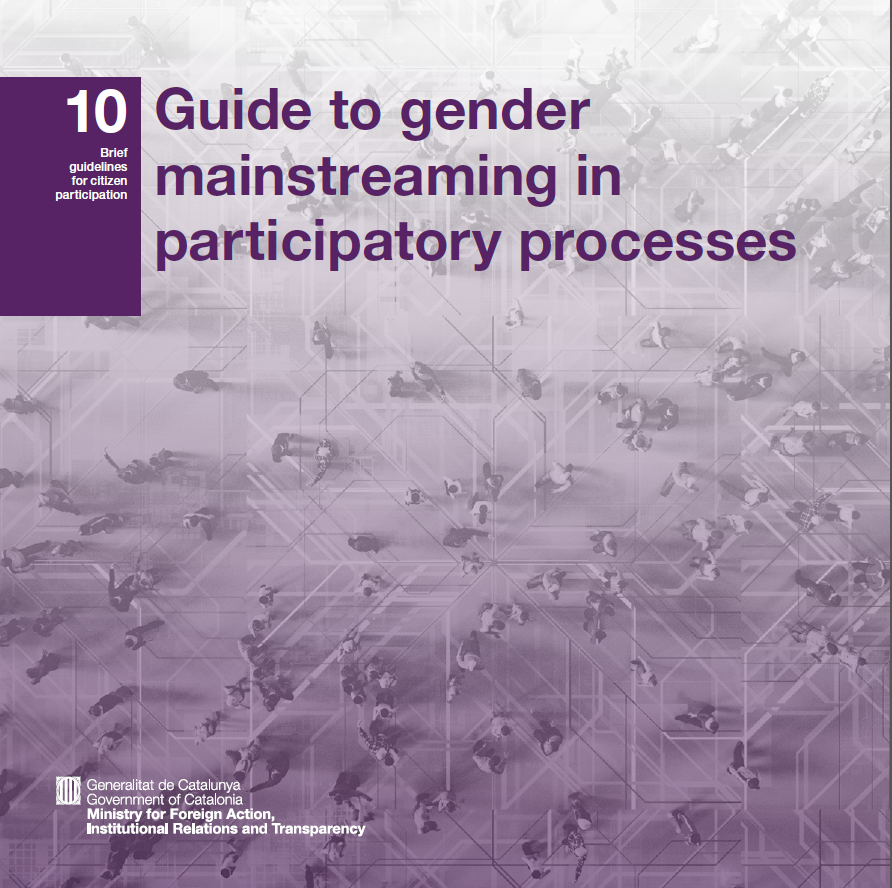
The result was triple. First, the aforementioned analysis and evaluation; second, a set of internal protocols to improve our own work; third, a Guide to gender mainstreaming in participatory processes so that anyone in the field of citizen participation can use and apply in their own citizen participation instruments.
The guide has been published in Catalan and English (see below) and the whole project was distinguished by the IOPD with a special mention in their distinction on the “Best Practice in Citizen Participation”, the award given annually by the International Observatory on Participatory Democracy to recognize public policies implemented by local governments.
Below one can download the guide and access the bibliography I personally used on gender planning and evaluation methodologies in relationship with citizen participation.
Downloads
Bibliography
Berbel Sánchez, S. & Geronès i Rovira, M. (2008). “
Participació política de les dones”. In Bodelón, E. & Giménez, P. (Coords.),
Desenvolupant els drets de les dones: Àmbits d'intervenció de les polítiques de gènere, Capítol 12, 199-231. Col·lecció Estudis, Sèrie Igualtat i Ciutadania, 2. Barcelona: Diputació de Barcelona.
Delatte, M., Guijarro, B., Almirall, J., Llop, N., Adell, H. & Medrano, A. (2018).
Anàlisi de la participació de dones en els espais institucionals i socials mixtos de la ciutat de Barcelona. Barcelona: Ajuntament de Barcelona, Liquen Data Lab.
Ecologistas en Acción (2018).
Patriarcalitest. Madrid: Ecologistas en Acción.
United Nations Human Settlements Programme (2012).
Gender Toolkit. New York: OCHA.
Xarxa d'Economia Solidària de Catalunya (2017b).
Reunions roDONES. Barcelona: XES.
By Ismael Peña-López (@ictlogist), 11 October 2020
Main categories: Development, Information Society, News, Writings
Other tags: antoni_gutierrez-rubi, carles_pont_sorribes, covid19
No Comments »
At the beginning of the COVID-19 crisis I wrote about the differential impact of crisis in the Information Society based on the first fact that were quickly becoming evident before our eyes and at plain sight.
Shortly after, professors Josep M. Reniu and Víctor Meseguer led a monography on how the COVID-19 crisis was impacting democratic institutions and what to do about it. The book ¿Política confinada? Nuevas tecnologías y toma de decisiones en un contexto de pandemia [Confined politics? New technologies and decision-making in a pandemic context] focuses on how institutions are responding to a pandemic that keeps people at home or away from each other, and how they are figuring out ways of keeping in touch with citizens and keep performing the tasks they have been committed to.
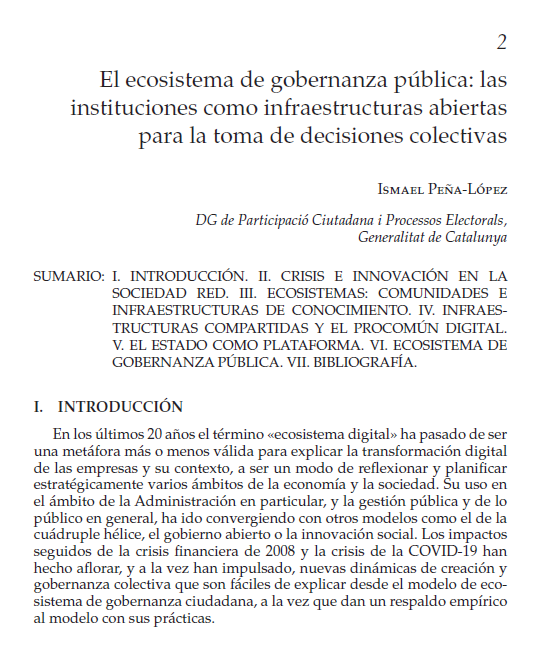
I wrote a book chapter, the second one, with the aim to provide a wide landscape on how democratic institutions and the democratic arena are configuring themselves, and how the pandemic crisis may be an accelerator to it. On El ecosistema de gobernanza pública: las instituciones como infraestructuras abiertas para la toma de decisiones colectivas [The ecosystem of public governance: institutions as open infrastructures for collective decision-making] I take the idea of the citizen participation ecosystem to a higher level, trying to scale it up to the global public governance level.
To do so, I introduce the concept of ecosystems on social sciences, which have been applied with much success —in my opinion— to describe the quick deployment of digital business infrastructures. I describe such ecosystems as knowledge communities and infrastructures that wrok in open and shared ways, aiming at the building of a digital commons. Following, I review the idea of ‘the state as a platform’, ending up with a definition and proposal of the ecosystem of public governance, which I define as:
A public governance ecosystem is a technopolitical, self-organized, autopoietic, replicable and scalable system that articulates actors, spaces and instruments around a set of open and distributed infrastructures rich on knowledge for collective decision-making.
A preprint of the whole chapter (in Spanish) and the bibliography I used can be accessed below.
Downloads
Bibliography
Chesbrough, H.W. (2003). “
The Era of Open Innovation”. In
MIT Sloan Management Review, Spring 2003, 35-41. Cambridge: MIT Sloan School of Management.
Dini, P., Darking, M., Rathbone, N., Vidal, M., Hernández, P., Ferronato, P., Briscoe, G. & Hendryx, S. (2005).
The Digital Ecosystems Research Vision: 2010 and Beyond. Brussels: European Commission.
Heimstädt, M., Saunderson, F. & Heath, T. (2014). “
Conceptualizing Open Data Ecosystems: A Timeline Analysis of Open Data Development in the UK”. In Parycek, P. & Edelmann, N. (Eds.),
CeDEM14. Proceedings of the International Conference for E-Democracy and Open Government 2014, 245-255. 21-23 May 2014, Danube University Krems, Austria. Krems: Edition Donau-Universität Krems.
Iansiti, M. & Levien, R. (2004). “
Strategy as Ecology”. In
Harvard Business Review, March 1, 2004. Cambridge: Harvard University.
Nachira, F., Nicolai, A., Dini, P., Le Louarn, M. & Rivera León, L. (Eds.) (2007).
Digital Business Ecosystems. Brussels: European Commission.
O’Reilly, T. (2011). “
Government as a Platform”. In
Innovations: Technology, Governance, Globalization, 6 (1), 13-40. Cambridge: MIT Press.
By Ismael Peña-López (@ictlogist), 20 April 2020
Main categories: Development, Information Society, News, Writings
Other tags: antoni_gutierrez-rubi, carles_pont_sorribes, covid19
1 Comment »
The crisis of the Coronavirus disease 2019 (COVID-19) is having an unequal impact on people, thus worsening the also unequal impact of globalization and the transition into the Information Society.
It is not only that wealthier and healthier people have more resources to face the crisis, but also that the way society is being reshaped (new relationships of production, experience and power) is also making more evident where we are facing as a society and what is becoming more obsolete. And the coronavirus crisis is especially hitting hard those tasks and institutions becoming obsolete.
But not only.
While two worlds overlap —the aging Industrial Era and the upcoming Information Era— there are also several views overlapping, and casting shadows that distort reality. There are some production sectors that are seen as obsolete by those in the Information Era, but that is becase positive externalities of their functions are not being taken into account.
This reflection has just been published as a book chapter, where I describe the uneven impact of the COVID-19, and why some social functions are really obsolete, but why some others should be revalued so that they do not disappear —and, on the contrary, should be treated with care.
The full book is called Comunicación política en tiempos de crisis (Political communication in times of crisis), coordinated by Antoni Gutiérrez-Rubí and Carles Pont Sorribes, to whom I am really thankful for putting together the book in such short time and by quickly inviting me to part of it.
My book chapter is entitled El impacto diferencial de las crisis en la Sociedad del Conocimiento (The differential impact of crisis in the Information Society) and can be downloaded below. All texts are in Spanish.
Downloads
By Ismael Peña-López (@ictlogist), 14 May 2019
Main categories: Development, Meetings
Other tags: branko_milanovic
No Comments »
Notes from the seminar on inequality by Branko Milanovic, organized by the Government of Catalonia and held in Barcelona, Spain, on 14 May 2019.
Branko Milanovic. World inequalities and the European social contract
After 1917 the world had a new way of production that lasted some decades and reached up to 1/3 of the population. And before, there were also different ways of production (e.g. slavery vs. free men, etc.) that lived together. This is not true anymore. Nowadays, capitalism rules alone —China being mostly capitalist in practical effects.
Global inequality has been rising since the early 1800s, stopped after WW1, rose again and stopped to grow once more after WW2. Around year 2000, due to the rise of Asia, global inequality begins to drop drastically. These are three periods: (1) fast growth of inequalities due to the Industrial Revolution, (2) the plateau of high but stable global inequality during the XXth century, (3) the decrease of global inequality due to the raise of Asia.
Europe (includes the US and the “Western” world) is shrinking at the global level: population, share of the global GDP, etc. This, among other things, means that other countries are catching up with European countries and some of their citizens are surpassing Western citizens in purchasing power. This does not mean that Europeans are moving down in absolute terms, but they do in relative terms: high income people from low income countries begin to be richer than low income people from high income countries.
There is an emergence of the global “middle/median class” and a shrinkage of national middle classes.
Migration is not something that will be a season matter. Migration will be with us for some decades. That is why it is so important. It will become structural at least for a very long time, as the tensions.
Another way to look at the tree ages according to inequality:
- Age of empires and class struggles, there is a divergence between countries and between classes.
- Age of the Three Worlds and diminished class conflict, with divergence at the peak.
- Age of convergence and internal cleavages.
We have 10% of the people of the World living the same way they were living 1,000 years ago, in absolute poverty. Yes, we have improved a lot, but we are still leaving a lot of people behind.
It seems that most equalising policy instruments —labor unions, education, taxation to the richest ones— seem to have reached their limit. And not withstanding, capital concentration is growing, especially at capturing its rents, and this is newly creating inequalities.
Can we de-concentrate capital? By what means? Taxing capital, stimulating new enterprises that create de-centralized (new) capital, etc.
The past 25 years in the rich world.
Political/philosophical issues brought up by looking at global, as opposed to only national, inequalities.
What kind of policies, and what can they do?
Discussion
Pere Almeda: is there a way that a global governance can control global finance / global capitalism? Branko Milanovic: On tax evasion that could actually work, also on tax dumping. But maybe not for other matters.
Mireia Borrell: why is it inequality bad? Is it “only” for moral reasons? Economic ones? Branko Milanovic: all of them apply. There is high impact by inequality on growth. See it, for instance, for gender discrimination and how inefficient it is to leave aside women’s talent.
Ismael Peña-López: we are not witnessing a growing de-materialization of capital, especially in the form of digital capital and knowledge. And some think that this democratizes the chance to access capital, as it is less costly an it is not finite (not a good with rivalry issues). There might be a tension between economies of networks and a digital-commons based production. Can the latter be a way to de-centralize capital? Milanovic: on the one hand, if capital ownership does not change, things might not change despite the fact that production technologies may. Besides, the definition of labor is changing a lot, so it really depends on how we define labor and capital and how we tax them. So the answer is not clear and it may vary a lot depending on definitions, ownership, taxation models, etc.
Natàlia Mas: what about fostering cooperatives? Branko Milanovic: a first interesting approach is how to make capital returns remain within the system, and be reinvested, put in innovation, etc. Another thing is how to work on ownership, like giving shares to their workers. This usually works, but it maybe would work better if not only top-workers got them, but all the workforce.
Jordi Angusto: how do we measure inequality better? will the gap between capital returns and labor returns keep on increasing? Branko Milanovic: technological change usually benefits owners of capital; as technological change will remain in the future (or increase), is is likely that capital owners will see their share in the global GDP grow. If we saw a democratisation of capital, that would certainly be the opposite case.
Marta Curto: given the mobility of capital, how do we tax capital? Branko Milanovic: it is very difficult indeed. Globalisation is like a huge tsunami and it is very difficult to tame. Pere Almeda: Maybe the creation of a global financial registry, but it would only be possible to do by a legitimised global organisation, which we have not.
Branko Milanovic: “homoploutia”: high capital and labor income received by the same people. Some people in the top are both capitalists and workers, which is a new thing compared to past times where one would be either one or the other, but never both. Homogamy has increased from 13% to 30% in 50 years. That is, what is the probability of someone at the top to marry someone also at the top. These two aspects make it more difficult to design policies that are effective in redistributing income or reduce inequality.